Showing posts with label ConsumerResearch. Show all posts

Monday, November 7, 2016

Unhinged From Reality – America Flirts With Fantasy Elections

(c) cbsmiami.files.wordpress.com

Are elections rigged? Maybe. Are they hacked? Could happen. Are they tampered with during shipment and handling? Poll workers and experts say no. What could they be hiding? What we know for sure is that in the era of the permanent campaign cycle...
  • We're sick with our own disgust.
  • There is a widening gulf between the electorate and the elected.
Representative government was the delivery vehicle for bringing democracy to the masses. But what are our collective roles as participants in that process? In the plot to undermine democracy, our deep and open doubts form one closely-held secret no one seems to be keeping. In this fifth national election in the young century, how do we identity as citizens?

Are we...
  1. Our social media check-ins?
  2. The sum of our political contributions?
  3. The tributaries formed by our gender roles and bloodlines?
To the electoral machinery the American voter is composed of: (a) a basket of friend requests to (b) one part debt load and (c) two parts gene pool. We know this because we hear about the path to victory and that path is lined with ethnicities, regions, income, and education levels. The boundaries that define our public lives are one in the same as our value to advertisers.

Contracting Voters

With that kind of calculation, is there any surprise that many hold regard for the vote as an endorsement of a system that has no other purpose for us? There may be some lingering guilt associated with betraying our servicemen and women's fight to preserve our right to it. There may be a perverse fascination for using the vote as a cudgel. If the ruling class compromises the social contract between the government and its citizens, why not just finish the job?

In 2016 the citizen-outsider is routinely exposed to groveling at fundraiser dinners and the spoils of privilege. On the virtual battlefield, the first amendment can just as easily be invoked over dark money and cyber warfare as it can over freedom of speech, the press, and assembly. As a world awash in WikiLeaks turns transparent, the more unhinged our conventional reality becomes. Think of elected leaders publicly worshipping at the altar of Horatio Alger. Now square that with a recent Derek Thompson piece in the Atlantic on America's Monopoly Problem:

"The land of the big. And the home of the consolidated."

It's not just that the status quo works for those in power. It's that the only power the average voter holds is to punish the system with their votes – however many entangled pieces may vaporize before the new administration takes office.

Vandalism in the Voting Booth

It's a sobering reminder:
  • Everyone's a special interest.
  • Everyone's a single interest voter.
But no one gets to pick how those single issues are strung together, let alone the candidates for speaking to them. A zero sum game is a ray of sunshine compared to the lose-lose proposition of a Clinton Trump victory. Both candidates defy all precedent in their unfavorables.

Never before have so many in one camp taken collective action to block, deny, and ultimately prevent the will of the other. Whoever emerges will earn a mandate – not to lead but to defend and deflect the howls of protest from the vengeful and affronted. When moral compasses run afoul of legal codes the disenfranchised are not only ostracized but banished from the larger community. The only option between conquest and surrender is the escape of withdrawal – to fantasy elections.

Level With My Playing Field

I've fixated lately on America's nose-diving attention to NFL games. At the core of football as social conventions are the rules and distractions of the non-events to be endured: first down measurements, thrown flags, PSAs, timeouts, stretchers, stats, less-than-instant replays of contested calls, and station identifications for starters.

Why do we want to throttle our  collective attentions – pull them off to the side of the road for the passing ambulance corps – when we can lock into the pay-offs of games called by our plays, players, strategies, and even our own rules. From the first tax loophole to the last tacked on amendment, what can be more American than playing by those?

Fantasy elections tackle another largely unaddressed need and that's a level playing field for rating politicians. Key to this shift is that voters and not fact-checkers are the ratings agencies. Not only do fantasy voters have the same fact base to draw from but they decide which facts on which to make that determination:
  1. Is the candidate an established politician? Then up comes crime stats, graduation rates, income levels, unemployment numbers and a host of pocketbook-slanted app counters.
  2. Are they here to entertain us? What are their follower numbers on social media? What kind of box office ratings do they attract and what attentions of ours do they pledge to hold if they win?
  3. Are they a titan of industry? How many jobs did they create, how much value did they return to shareholders, and how much of it was shared among the wider communities impacted by their success?
As great as dislodging the media might be to us craven messenger-shooters, this middle-man elimination scheme pales in comparison to the ultimate removal – YES! The yanking of the Republican and Democratic umbilicals from the womb of the American electorate.

In such a scenario the color wars of red and blue, the racial rancor of black and white, the belief battles between religion and science and that widening gulf between the one percent and the remaining population on earth. That great reckoning is about liking, loathing, and/or reserving judgment on the myriad of stances, roles, policy positions, and alliances that collect around the limited choices we have in a candidate X versus Y world of today.

Scheduled Departures

With fantasy elections voting freedoms are extended to a list of top ten issues. These picks are not subject to the whim of mass shootings, unscripted gaffes, or other orchestrated surprises. As a set of chronic conditions and tough problems, they are resistant to the whirlpool of visceral gratification that pulses through the cable news circuit. They are not a list to be bought or placated by a power-broker. There will be repeated tallies throughout the play-offs – um, I mean primaries – where fantasy voters can begin linking their leanings to the stances they're hearing on the campaign trail: 
  1. Imagine a time when an agnostic voter can bypass abortion entirely?
  2. Fathom a contest where pro-lifers can step over the commotion about where to send troops under which war game scenario?
  3. Dream of a debate where a deficit hawk can tie entitlement spending to the non-partisan fact that fewer workers are supporting more retirees?
  4. Conceive of a world where a living wage bill garners more attention than elderly elites waxing nostalgic about their self-made careers?

Fantasy or Fiction

Fantasy elections permit the voter the satisfaction of not only voicing their concerns but choosing the issues that concern them in the first place. Politicians can't choose us like voting cattle from some big data stockpile. They can't pony up based on delivery us like some kind of tribally-connected takeout order arranged according to a standard issuance of dog whistles:
  • So-and-so's trying to take away your such-and-such
  • This-and-that's trying to make you pay their way and their wares and cares.
My favorite accusation comes from this morning's checkout at the North Hadley Sugar Shack. Shannon Kendrick describes the self-interested participation of the political classes as paying $ thousands a plate at a fundraiser without pennies towards helping to feed a needy family. The point here is that American greatness can only occur when Americans are engaged on the merits of our ideals and not the electoral math of our demographics: Represent us for our resourceful minds – not our feeble, unyielding body parts.

To paraphrase the late Tip O’Neil: All politics is (not only) local. It's frontal lobal. That's an Election Day fantasy that can bring democracy back to the ballot, no matter who wins tomorrow or presents evidence of rigging on the day after. That's my love-of-country naivete running full mast.

Unhinged From Reality – America Flirts With Fantasy Elections


Are elections rigged? Maybe. Are they hacked? Could happen. Are they tampered with during shipment and handling? Poll workers and experts say no. What could they be hiding? What we know for sure is that in the era of the permanent campaign cycle...
  • We're sick with our own disgust.
  • There is a widening gulf between the electorate and the elected.
Representative government was the delivery vehicle for bringing democracy to the masses. But what are our collective roles as participants in that process? In the plot to undermine democracy, our deep and open doubts form: (a) a national consensus, and (2) one secret no one seems to be keeping. In this fifth national election in the young century, what is our proper role as citizens?

Are we...
  1. Our social media check-ins?
  2. The sum of our political contributions?
  3. The tributaries formed by our gender roles and bloodlines?
To the electoral machinery the American voter is composed of: (a) a basket of friend requests to (b) one part debt load and (c) two parts gene pool. We know this because we hear about the path to victory and that path is lined with ethnicities, regions, income, and education levels. The boundaries that define our public lives are one in the same as our value to advertisers.

Contracting Voters

With that kind of calculation is there any surprise that many hold regard for the vote as an endorsement of a system that has no other purpose for us? There may be some lingering guilt associated with betraying our servicemen and women's fight to preserve our right to it. There may well be a perverse fascination for using the vote as a cudgel. If the ruling class compromises the social contract between the government and its citizens, why not just finish the job?

In 2016 the citizen-outsider needs no special favor to witness the insider trading, groveling at fundraiser dinners, and the revolving door from elected office to privileged relationships. On the virtual battlefield, the first amendment can just as easily be invoked over dark money and cyber warfare as it can over freedom of speech, the press, and assembly. As a world awash in WikiLeaks turns transparent, the more delusional our conventional reality becomes. Think of elected leaders publically worshipping at the altar of Horatio Alger and square that with a recent Derek Thompson piece in the Atlantic on America's Monopoly Problem:

"The land of the big. And the home of the consolidated."

It's not just that the status quo works for those in power. It's that the only power the average voter holds is to punish the system with their votes – however many entangled pieces may vaporize before the new administration takes office.

Vandalism in the Voting Booth

It's a sobering reminder:
  • Everyone's a special interest.
  • Everyone's a single interest voter.
But no one gets to pick how those single issues are strung together, let alone the candidates for speaking to them. A zero sum game is a ray of sunshine compared to the lose-lose proposition of a Clinton Trump victory. Both candidates defy all precedent in their unfavorables while conspiring to create one of the highest turnouts on record.

Never before have so many in one camp taken collective action to block, deny, and ultimately prevent the will of the other. Whoever emerges will earn a mandate – not to lead but to defend and deflect the howls of protest from the vengeful and affronted. When moral compasses run afoul of legal codes the disenfranchised are not only ostracized but banished from the larger community. The only option between conquest and surrender is the escape of withdrawal – to fantasy elections.

Level With My Playing Field

I've fixated lately on America's nose-diving attention to NFL games. At the core of football as distraction are the conventions of rules and trappings of the non-events to be endured: first down measurements, thrown flags, PSAs, timeouts, stretchers, stats, commercials, and station identifications for starters.

Why do we want to throttle our  collective attentions – pull them off to the side of the road for the passing ambulance corps – when we can lock into the pay-offs of games called by our plays, players, strategies, and even our own rules. From the first tax loophole to the last tacked on amendment, what can be more American than playing by those?

Fantasy elections tackle another largely unaddressed need and that's a level playing field for rating politicians. Key to this shift is that voters and not fact-checkers are the ratings agencies. Not only do fantasy voters have the same fact base to draw from but they decide which facts on which to make that determination:
  1. Is the candidate an established politician? Then up comes crime stats, graduation rates, income levels, unemployment numbers and a host of pocketbook-slanted app counters.
  2. Is the candidate an entertainer? What are their follower numbers on social media? What kind of box office ratings do they attract and what attentions of ours do they pledge to hold if they win?
  3. Are they a titan of industry? How many jobs did they create, how much value did they return to shareholders, and how much of it was shared among the wider communities impacted by their success?
As great as dislodging the media might be to us craven messenger-shooters, this middle-man elimination scheme pales in comparison to the ultimate removal – YES!

The yanking of the Republican and Democratic umbilicals from the womb of the American electorate. In such a scenario the color wars of red and blue, the racial rancor of black and white, the belief battles between religion and science and that widening gulf between the 1% and the remaining population on earth. That great reckoning is about liking, loathing, and/or reserving judgment on the myriad of stances, roles, policy positions, and alliances that collect around the limited choices we have in a candidate X versus Y world of today.

Scheduled Departures

With fantasy elections voting freedoms are extended to a list of top ten issues. These picks are not subject to the whim of mass shootings, unscripted gaffes, or other orchestrated surprises. As a set of chronic conditions and tough problems, they are resistant to the whirlpool of visceral gratification that pulses through the cable news circuit. They are not a list to be bought or placated by a power-broker. There will be repeated tallies throughout the play-offs – um, I mean primaries – where fantasy voters can begin linking their leanings to the stances they're hearing on the campaign trail: 
  1. Imagine a time when an agnostic voter can bypass abortion entirely?
  2. Fathom a contest where pro-lifers can step over the commotion about where to send troops under which war game scenario?
  3. Dream of a debate where a deficit hawk can tie entitlement spending to the non-partisan fact that fewer workers are supporting more retirees?
  4. Conceive of a world where a living wage bill garners more attention than elderly white elites waxing nostalgic about their self-made careers?

Fantasy or Fiction

Fantasy elections permit the voter the satisfaction of not only voicing their concerns but choosing the issues that concern them in the first place. Politicians can't choose us like voting cattle from some demography-based meat market. They can't pony up based on delivery us like some kind of tribally-connected takeout order arranged according to a standard issuance of dog whistles:
  • So-and-so's trying to take away your such-and-such
  • This-and-that's trying to make you pay their way and their wares and cares.
My favorite accusation comes from this morning's checkout at the North Hadley Sugar Shack. Shannon Kendrick describes the self-interested participation of the political classes as paying $ thousands a plate at a fundraiser without pennies towards helping to feed a needy family. The point here is that American greatness can only occur when Americans are engaged for our ideals and not our demographics: Represent us for our resourceful minds – not our feeble, unyielding body parts.


To paraphrase the late Tip O’Neil: All politics is (not only) local. It's frontal lobal. That's an Election Day fantasy that can bring democracy back to the ballot, no matter who wins tomorrow or protests the day after.

Sunday, February 23, 2014

VISA to Consumers: I Think We're Done Here

[youtube=http://youtu.be/xR1ckgXN8G0]

Last week Jerry Seinfeld performed a killer rant on Jimmy Fallon about the ritual of the Post Master General coming hat-in-hand to congress to close the latest loophole in the postal service budget. The critique of the post office as the public face of government dysfunction is especially spot-on after a week of having my mail service suspended because my mail carrier refuses to get out of his truck when the pile-up of mid-winter snow prevents him from providing drive-through service.

Seinfeld connects antisocial smart phone etiquette with the temptation to treat the listening-back side of conflict resolution as an antiquated nicety that's been marginalized by the self-selecting way we choose not to engage directly in disagreements -- especially when those disagreements may cost lenders and issuers money as well as attention to customers without risk management operations of their own.

The I-could-have-called-you-and-I chose-not-to option is how VISA apparently resolves its one-sided dialoging of credit card disputes these days. Only they don't email or text either. The U.S. postal service is the vehicle of choice for phantom, unilateral negotiations already rigged in favor of the risk management services wing of America's prospering financial services sector -- the same industry that hemorrhages our identities and personal fiscal affects at checkout registers from coast-to-coast.

They rely on the US postal service -- the same  channel both clogged and sustained by retailer offers for their plastic. Then the too-big-to-fail folks carve out a tiny window to respond to this post resolution second round of paperwork. I heard a muted apology over the phone last week that this window lasts for ten  days. That's almost the duration I've been without mail service during our recent winter storm surge.

Actually, 'tiny' may be too large an opening for what they provide when the consumer doesn't even know that window has been opened, or reopened in this case. That's because in the interest of fairness I asked for one-half of the dispute to be re-credited to my account. After attempting to contact the merchant and filling the necessary paperwork my card issuer, TD Bank did exactly that. Only they put the charges back. An unannounced debit to my account surfaced 10 days ago: the amount of days to resolve a dispute by VISA's watch and four months after I filed my original dispute with the merchant.

In the letter I filed last fall with TD Card Services I documented my communications with ABV Kayak and Excursions on the Riviere Rouge in the town of Grenville, about 50 miles northwest of Montreal near Parc du national Mont Tremblant. The business consists of a website, Facebook page, a school bus, van, some kayaks, crash helmets, paddles, rubber suits, contractor-instructors, and a bucket of suds that the guests use to wash the bodily fluids from the prior wet suit occupants.  If you believe the marketing this shadow operation has escorted 150,000 auteur kayakers down river from their rented rec hall in the splendors of the Laurentians since 1981.

When I first contacted the marketing arm, the sales associate informed me that a full day trip would be broken into two parts, with lunch in between. I told her we weren’t sure that we wanted to do a full day of rafting. She assured me that the variety of currents, peak season scenery, and topography would make the full day trip well worth it.

However, when we got there, ABV informed us that the afternoon part would merely duplicate the morning run, and pass the exact same portion of the exact same river as in the morning run. We did not want to do the same trip twice and were mislead by the merchant's misrepresentation that the full day excursion had different morning and afternoon parts.

We took only the morning part of the trip. ABV’s representative asked us to call the office the following Monday, and inform the office staff. He said that ABV Kayak Excursions would refund the unused afternoon portion of our trip, which is $244.23. I did try to reach the ABV office upon return. No one responded, We were mislead into booking a full day excursion, did not in fact take a full day excursion, and do not believe we should have to pay for a full day excursion.

It would appear that TD Bank agreed as well. These were the details that prompted the partial refund. As for putting them back on my card I'll say this: I would answer for the counterclaims that ABV made on its own behalf except that TD Services now refuses to share them with me.

It must be something about the foregone closure of those tiny windows where dispute resolutions tend to dissipate in the bank's favor. I suppose if Seinfeld was mocking the kangaroo court of hearing out its customers, he might say that our credit institutions and banks had come to an executive decision before this dispute ever arose:

"I decided I only want to hear my half of the conversation. This is what I have to say...

I think we're done here."

Wednesday, February 5, 2014

Dreams in Headlights: Her Impersonates a Future That Commoditizes Love

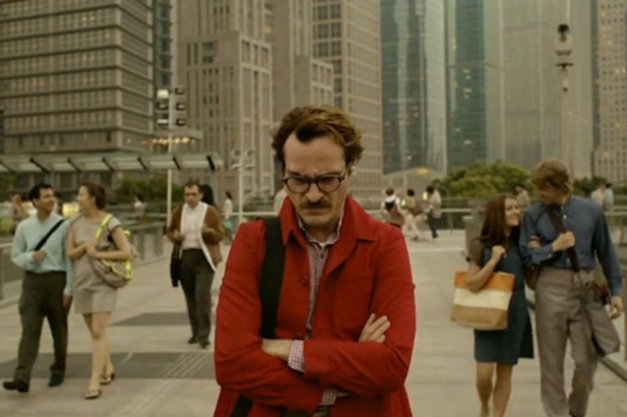
ImageTo paraphrase David Byrne, in Spike Jonze's not-to-distant time horizon, the future depicted in the movie Her is …
A place where nothing ever happens.

For instance, creative achievement is evidenced as a documentary of a mother sleeping. No, not a work about sleep or moms or nocturnal maternal emissions. The camera is frozen on a static star of a sleep study.

Is this a tribute to slow TV or simply the vacuous expanse of uninspired alienation that awaits us past the end of history? Joaquin Phoenix's character is a greeting card dictator-turned-personal-history-arranger. By his own admission he's run the gamut of human experience in only slightly more than one-third of his biological life. It's all patterned out, as if the big data wheel of probability already lived it for him. Of course there's no great expanse of history or imagination to cross for the audience to conceive of no greater turn-on for our protagonist than a woman he can turn off at will (a.k.a. Scarlett Johansson ... as Samantha ... as Her).

But to arrive at that exalted and zipless state, we must first climb over the encumbrances of mid-21st century Los Angeles. It's not a high, low or middle society so much as a neutered and frictionless tunnel of over-educated, close, but not touching (and yet so touchy) automatons, leading lives that appear more simulated than stimulating.

Don’t Touch the Exhibits

There is nothing Dystopian in the infrastructure. There are no marauding packs of feral gypsy gang lords. No one is warming over a post carbon, methane crisp at the beaches of tomorrow. The biggest obstacle for Theodore is to avoid stepping on the ankles and torsos of the wedged-in open house of Next Gen sun worshippers. Wealth distribution's been all figured out. Traffic patterns have been scheduled in advance. The obese and diabetic have retired to off-screen leper colonies. Convincing meds have released a drug-free world from the labors of addiction. Hostility means you're carrying someone else's baggage. And they're just as happy if you don't.

Most of the movie's confrontations are big drawn-out clashes of the genders. Relationships are skirmishes waiting to happen. Ironically Theodore's metro sexual manliness is hailed by his office mate and inspires his first post-divorce dating encounter. No sooner can you say restaurant selection anxiety disorder, his magic conquest carpet is rolled in and scorched by his blindsided dinner date. Her advanced academic pedigree belies her naughty school charms. The unfreezing of his flowing juices pushes her abandonment buttons: Is he the whole prayer resolution package or drive-by sleaze bag from the same package store?

Tender Generic Mercies

My favorite set-up to the zipless intelligent soul design climax has little to do with dating freak-outs or similarly ill-formed flashbacks of a brawny-brained, emotionally-stunted ex-spouse. It's the facade of authenticity provided by Theodore's gift of verbal approximation of generic intimacy. Sort of a SIRI bookstore reading of a texting-happy Hallmark laureate. Add the idyllic trappings of an imagined togetherness never actually shared  by the customers who dial-in Theodore's prose because their own reticence blocks the connective emotional tissue from forming around we still know too casually as a commitment to our significant someone.

The manufacture of superficial intimacy tees up with the artificial intelligence cocktail in ways that the servant-turned-antagonist (2001) and Pinocchio-kindled parental love (AI) could only break down as instruction sets. The messier business of decoding our emotional bearings from bedroom, to alter, to probate finds the AI cinema formula in rare and elastic form, stretching to accommodate our most far away looks. We're gaping into our own dreaminess with an impunity reserved in our time for control freaks of the rich and famous. It's the AI elements that enable this immersive bubble of mirth to mushroom without risk, or guilt, or the slightest creeping realization that the rest of our better selves are engulfed by that same indelible reflection. It's that temptation to be dreaming around the campfire of the oncoming headlights. Entrapment by entrancement. Anything less than Her is tabled as a to-do list item for some day, any day, eventually following tomorrow.

Her Fast Acting Majesty

The deliberate invocation of a nearby future was decided by Jonze first and foremost to get us vested in the outcome -- that we would see this day evolve, if not the actual artifice. I'm also guessing it was not so much to raise expectations on that future so much as lower our guard on the present close at hand. Our solipsistic romance with the immediacies captured in our smart phone of yesteryear is replaced by companionship, configured from best practices associated with...

  • Childlike curiosity

  • Canine loyalty

  • Valentino romance

  • Monster lust

  • Spongy, experiential absorption

  • Meticulous virtual house-keeping (including the pruning and curation of 86,000 ponderous emails), and

  • The tenacity of a professional agent


The enormity of that attention to detail enables Her to repackage the small funny subset to a welcoming market for those messages (as if that market was speaking in a voice only Her could hear above the conversation-neutrality of our talkative interactions).

Sexperimentation

The use of surrogates is another playful glimpse into a plausible future through Google-tinted glasses. We see a salty-tongued Pillsbury Dough Boy impersonator channeling Seth McFarland through 3D PlayStation whose console transforms every finger into their speediest, thumb-texting best.

The sex surrogate portrays the physical semblance of the disembodied OS. Our human body double is a willing accomplice. But Theodore can't bridge the distance between autopilot lust and the deeper complexities of his true OS affections. Ultimately it's not the absence of the human form but the presence of an emotional dishonesty that drives Theodore and Her apart and dwarves the convenience factors in the value proposition of OS as a delivery system for love. To Theodore it is no longer fantasy. To those outside this circle, there is no "couple." The breakup to be is a head-trip, not a spiritual journey.

Looking for Mister Sidebar

Her doesn't cheat so much as mutate into a superior intelligence of fortune. Her seeks out the philosophical entrails of cryogenically laced celestial packing über thinkers. Her keeping up with Theodore as customer-master is now expressed by how far the teacher and student roles have reversed. At one point she's engaging thousands of other game piece-like presences while Theodore is passing the time on a train, asking Her to guess an exact number for the thousands of trees passing across the landscape. In that moment Her is the closest to human that Jonze can spin his creation. That's when the OS senses the suspicion of being cheated out of love. It is this fragility in our mating rituals where Her attention to Theodore is now and forever divided -- no matter how attentive the engineering being performed is lavished on us.

I will replay this film in my mind over and over again. It's not because of unexpected plot twists, stellar performances, or even a memorable relationship, but for this core notion of a masterful concept movie: Our attention is our most prized possession and how this stokes our passions, compromises our generosities, and seeps into all there is to love and ponder in our commitments to one another.

Friday, January 3, 2014

The Philanthropilization of Commerce

[caption id="" align="alignleft" width="487"]Image Clean-up crew descends on Great Pacific Garbage Patch[/caption]

Since our species has evolved from hunting, gathering, ducking, and unplucking, our trading systems have moved up the same maturity chain. Once cowing, plowing, and bowing to lords and kings, we are no longer judged on what we produce but how we acquire. And while we agonize over how this all reflects on our values and grandchildren, our unblinking systems patiently await our future purchasing histories.

In a couple of dozen centuries we've gone from unwritten agreements and provincial codes to the recording of every articulation and graphical utterance. From fist clenches and handshakes to security tokens and payment releases.

Our free modern markets are at the ready for setting prices and finalizing sales but speechless when it comes to processing the loss of things once valued but never priced. We lose radio contact with value at the point where cheaper is the rationale for shortening a supply chain, doing more with less, not covering preexisting conditions, and the familiar litany of "house bets." Those free market calculations designed to lower prices without regard to their costs.

The Tyranny of the Free

Any 21st Century content connoisseur will tell you that we are drowning in the social costs for making information free. Information for a price is a world in which producers compete to know the priciest information, and then trade on that knowledge, benefiting the information, the linings of of their pockets, and the trading systems that carry their instructions. The world of free belongs to all of us and we're drowning in the details. It's a fishbowl, echo chamber, and labyrinth of transactions. A ticker-tape parade of personal metadata confetti. Our own claims of privacy aboard a Texas-sized flotilla of personal information garbage, brought to us by opaque password bypassers and lax regulations (with a capable assist from our own lethargy).

Is it any wonder we can't build a consensus around a set of shared priorities in a world where everyone gets to hear themselves think and the slightest dissension is an unwelcome distraction?

I'm not suggesting we go back to a world of publishing magnets, three national TV networks, and gatekeepers who defined the public interest through the prism of their own. But just because the content spigot is more control resistant  these days doesn't mean the biggest media mouths and ears can go on smearing and eavesdropping with impunity. And that brings us back to the marketplace of ideas where we shop. In these kiosks and stalls and pushcarts anyone with a bill-supporting income can ascend to the roll of benefactor -- a supporter of sounds, tastes, looks, and priorities that amplify our sense of what counts, knowing that the dollar we spend will be counted regardless of what the counters are thinking in their calculations.

Keepers of the Analog

Being a patron of the arts is not just about buying your CDs directly from the performers as mementos of the concert experience. It's more basic than that. It's about preserving the musical worship ritual itself.

The highlight of this past gift-giving season centered on buying two albums at Newbury Comics for my wry-witted, macro-analytical, and culturally clairvoyant step daughters. It felt both odd and compelling that the $40 for the two works equaled ten LPs back in the golden days of Disc-O-Mat, Sam Goody's, and Titus Oaks. It was also a trifle under the $40 more that I've managed to spend on downloads through the 2013 music season. But I'd be just as mistaken to confer a 1979 dollar value on the post record label musical food chain as I would for labeling the LP, its fluffy sleeves, luxuriating foldouts, and epic cover art as mere "packaging." Behind that hedonistic splurging of harmonic layerings lies a tactile immersion that focuses the mind on the concept behind the album, the liner notes behind the lyrics, the devotion to the vision in the sound.

If vinyl makes a comeback, can other pay-for-content packagings be revivable? Printing and reading text on paper instead of screens has a way of marshalling the concentration that is otherwise claimed by the labors of a competitive world, i.e. memorizing answers to tests. Another clarifying benefit of paper-based information is that it's static, doesn't beep or flicker, and awaits the scratching within the editorial margins to activate the reader. Print on screen is content that never sleeps. It's resistant to reflection, analysis, and the perspective-taking carried by the authority of definitive works.

We've lost that one big time in the online.

The Future Makes a Comeback

The question of getting it back is not reducible to whether there's a business model for offline content or a marketing edge for self-referential authority. The answer is to pay for the information whose usefulness will grow with time.

That doesn't mean a pointless retreat into a nostalgic past of argument-settling finality. It does mean cultivating the restraint, introspection, and deference given to containers that not only preserve the original contents but reveal that larger framework for committing positive and memorable change in our unyielding and inarticulate age. A time where the present is no better suited to take in the future than the haste and prejudice of our own self-selection.

Question: When the last time you picked over the hidden messages and visual nuances of the art on a CD cover? If you're like me you're harkening back to a time that never passed because it never happened. It's funny what choices the free, modern marketplaces make for us. Especially the choices it takes away that were never counted in the first place.

Monday, October 28, 2013

"Go See Your Uncle Stephen."

ImageWhen I was young, spongy, unformed and self-absorbed I attended a young, idealistic, and small New England college. Hampshire convinced flocking Hamsters like me that you could mold that spongy absorption into your career clay, your alloy of choice.

My Hampshire diploma was my pink slip from the self-made sculpting factory. I received it 1984. "Morning in America" was my early wake-up nightmare to the reality that the days of self-made expressions visited on Kangaroo review committees had no currency outside of Camp Hamp.

I do remember the deflated bubbles, the kicks to the curb, and the queasy disorientation from the world of ideas to the world of shelter and clothing. But mostly I remember the woman with the megaphone blaring into my fallen house of young adulthood. The megaphoner-inner would be Grandma Harriet. Grandma would say:
"Go see your Uncle Stephen. He's very smart."

It wasn't a threat and it wasn't quite a reward. But there was an implied "... or else." Don't go ... at your own peril.

Harriet saw my bachelor’s degree from the self-ordained and the bona fide flakiness that comes with encouraging (if not outright expecting) payment for self-expression. Her suggestion felt more like an order. It's not that I lacked direction, role models, or a running list of intriguing career outfits to try on. She said go see your uncle because whenever I expressed those ambitions or desires she was clueless what I was talking about. She said go see Uncle Stephen because that was the single most direct way out of my head and into a job that paid something.

Career Characters


Stephen I should point out was not just Uncle Stephen. He had the unjaundiced eye. He wished the best for his little kid sister's oldest son. He defined that wish by the roles of people he'd either portrayed or tried to persuade through his own unflinching candor:

  • The collateral-seeking lender,

  • The risk-averse hiring manager,

  • The status-conscious schmoozer, or,

  • The distracted indifference of the restless producer.


ImageIt was that parade of characters who found their way into Stephen's mini publishing empire. For a 25 year stretch he and Mark Levine lined the Barnes and Noble self-help table with field guides, coaching manuals and life scripts. He wasn't just in my corner and kicking my ass. This was Uncle Stephen, one of America's leading personal finance mentors and a professional life strategist. His perceptions and influence fell into orbits that traveled far and wide of our extended family circle. Inside that circle, Stephen was the official voice of reason. He talked me through my unofficial failures to launch as a twenty-something. He talked me through my improvised workarounds. There were many of those.

Diplomas from Schools of Doubt


* I could tell you that a review copy of a runaway Stephen bestseller was my take home homework from those earlier coaching sessions. That would be misleading. He's always shown more interest in refining, channeling and ultimately investing his clients in their own destinies where self-discovery drives the narrative.

* I could tell you that I used the nesting impulse to impose my need for control and practicality onto my personal life.  I could tell you that I plunked my young adult savings down on a Park Slope co-op and road the coattails of the NYC real estate boom to financial stability. That would be someone else's investment success. Spoiler-alert: I held onto that apartment for a decade and still managed to lose 10% of the original sale price.

* I could tell you that I down-shifted from career drive to a more family-based focus. But my life's been one protracted stretch between where I work and where I live. That split has factored into great disruption, upheaval, and dissolution of several marriages.

So I won't lie. I will tell you straight as (Harriet is my witness) that Stephen is my secular rabbi and spiritual bookkeeper. In nearly all of Stephen's many interventions (barters, guiding questions, and petitions for my practicality) he's given me the gift of perspective-taking. He helped me unload the professional baggage we carry when the career options we select don't choose us back.

Our job, as he's often counseled, doesn't define us or who or what we mean to the people we cherish. It's a stream of income. It's just as fluid and prone to change as our income stream prospects.

13 Step Program


I went back to visit Stephen recently. It wasn't that I needed career advice, negotiation pointers for some negotiation in the balance, or greater appreciation for letting go of forces beyond my control.

I needed to tell him about a wonderful new job that among other things caused people I barely know to contact me out of the blue for career pointers and job-hunting approaches. I told Stephen that the experiences are my firsthand bumps and mid-course corrections. The messaging, however, is a page straight from the Stephen playbook. That alignment between personal ambition and market reality is a lifetime balancing act written, produced, and scored by Stephen Pollan.

The day I got to his office, his current admin (in a bad run of temporary admins) had bailed on the later afternoon appointments. Fresh from an AM appointment the same day, my sister-in-law prepared me for the empty reception area and the likelihood that Stephen would be jumping through honking congestion to make it back for our 4 pm (-- he strode in at 4:01 without breaking a sweat and asking how late he was).

I noticed then that his bookcases were bare and the wall was lined with moving crates. He had his office bags packed. No more cross-town hurdle-jumping wind sprints. Just an elevator commute from his east-side residence to a first floor professional suite in the same building.

He told me that he was starting his newest book. The working title? The Tyranny of Self. He wasn't too attached to it as he offered to let me steal it. After enough of Stephen's counsel, I understand. This was the 13th in a 12 step program to address the same demons I confronted when I left Hampshire: The raging seduction of a workaholic, who hides behind the virtue of the provider, and in the concealment, loses the dignity of his labor.

They share their better selves with the work, not with the selected people that a less involved laborer would simply understand as their home, their shelter from the ungenerous world. After enough trips to Stephen, I understand the need to give away working titles.

Wednesday, August 7, 2013

Revenge of the Passwords

[caption id="" align="alignleft" width="290"]Image (c) http://mrcracker.com/2012/02/password-cracking-part-1-passwords/[/caption]

What is that invisible and shifting divide between helpful and hindrance? Between being useful and being used? Between being a consumer assisted by a labor-saving device and an unsuspecting supplicant being consumed by a tech consumer juggernaut? This boundary is often defined along age lines, between geeks and luddites, Silicon Valley versus the rest of us, etc.

But those boundaries can come down any time they're crossed. And they're being crossed faster these days than we know where those borders are shifting to. Do I want my sleep compromised by the timely interruption of the forecasted obstacles in the day ahead? Do I want my robo-car decelerating at the hint of a green-to-yellow traffic signal? If I pre-set my controls to accelerate for yellow lights will my settings be overridden by drivers willing to pay more for their need to run yellow lights (or outrun traffic laws)?

As Claire Cain Miller points out in last week's New York Times piece "Apps That Know What You Want, Before You Do," the lines between creepy and cool are not always so clear. Even drawing them to familiar boundaries can redefine whether these lines are crossable or whether we know which side of the divide we favor.

How about an app that tells you your team has stormed back from extinction and is on the verge of a heroic comeback? Who could argue with good unexpected news?

You don't need to be a sage in your gray beard years to form a healthy distrust of one's short-term memory. How about an app that guesses at all the PINs you favored the last time you checked your miles for a carrier you haven't flown on since all the unused points were traded for magazines that had since suspended publication?

It's the scope creep that shadows us in our expectations that our corrosive bodies can keep pace with our supple minds. By the time we hit 50 we have a strategy for nearly all the unexpected we can fathom from our heads, hearts, and stomachs. That's where the specter of a programmable salad of personal apps sounds more suggestive than proscriptive, more about limiting choices than about optimizing the meaning of direct experience. That's a world where we're reaching out to engage skin, bark, dirt, and surf at the expense of touching another screen. But it's not just the sensual world. It's the fragility of our rattled dispositions. We need time to absorb the untimeliest of blows. Lay-offs, divorces, suicide watches, and cancer readouts are not necessarily what we want scanned into calendars, socialized to networks, or tracked by prognosis. The machine is there to mitigate the risk to the programmer, not the defective nature of the harboring human. Are we really being blacklisted when we're disinvited from events that don't support the commercial aims of the event planner?

One of the guys interviewed for the piece put it this way:

“We have a technology that isn’t waiting for you to ask it a question, but is anticipating what you need and when is the best time to deliver that.”

It's helpful when the trajectories of predictive search factor in traffic patterns. I'm positively elated when my phone asks if I want to disable the shake to shuffle. You know I do. Maybe it will grow fonts as big as my visual deficits when it detects how big my faultering eyes need to enlarge interfaces? Until then a few more developers have to turn middle age, And create a clapper for all that as yet unattached body armor we leave behind. Most likely these will be from appointments we had little hand in scheduling. And that's fine with a delivery system in which the messenger and message shaper are one in the same:

“The better we can provide information, even without you asking for it, the better we can provide commercial information people are excited to be promoting to you,” Larry Page, Google’s chief executive, told analysts in April.

Friday, June 14, 2013

A Problem Child Named Big Brother

Image

The media has fixated under this past week’s news leak that all Americans are now and forever spied on until proven dead. Wait … that might not be provable. This revelation casts a glaring light on the low profile and high concept surveillance innovators within the clandestine NSA – the part of our intelligence community that makes the CIA seem catty and loose-lipped.

There was something both alarming and innocuous about the story that broke in the Guardian on June 6th. This snooping or PRISM program is a vast soup of browser logs, text, graphics, videos, voice calls, and all manner of singing, dancing, and soliciting from my screen, to yours, and your next of yours. Think of the color-coded warning systems from the Bush era reformatted by degrees of separation and you begin to see Obama era risk assessment through the PRISM lens.  Concepts like criminal motive or case relevance have been replaced by the pervasive need to place our electronic selves under a passive and insidious house arrest.

Now I like to connect hypothetical dots like the next armchair analyst. But I resist the sweeping explanatory powers of slam dunk conspiracy theories. I’ve always maintained that paranoia is a luxury of the self-important. Our lives are much more open, generic, and predictive as data patterns than we are as erratic and complex individuals.

So before we start quaking in Orwellian tones, let's give the NSA its day in our court of opinion. Even if they answer in confidence to secret courts, it makes sense to vet the rationales behind such a deliberate and undiscriminating assault on our virtual identities. Besides we’re all part of the same feuding and dysfunctional family. If we know Big Brother’s allegiances and loyalties maybe he won’t seem so poker-faced, inscrutable, and extortion-prone.
Equal Mistreatment

First of all, it boils down to fairness. After all, what could be more even-handed than to spy on everyone? How could anyone feel frozen out of the action or singled out for selective treatment?

Secondly, when it comes to justice systems you can't bet against the house. That's because the PRISM guardians own all the evidence. You need to play by their rules to prove: (a) they're not following them as (b) they are following you. It's a circular tail-wags-dog-chasing-own-tail situation. It’s designed to tie tea party activists and ACLU partisans in knots for years to come. You say your rights are violated? Hard to try your case when your first amendment freedoms have been guantanamoed down in broad constitutional daylight. That's the blank check known as the Patriot Act -- the NSA having its way within the exigencies of perceived threats. Case closed.

And even without a public trial, there’s a great potential in PRISM for self-inflicted embarrassment. What if Big Brother arrests the wrong guy and that guy is you or me? That’s the advantage of secrecy. It’s botched raid insurance. It’s a hedge against hiring the wrong henchmen. It’s the peace of mind that comes with plausible deniability -- the first mover freedom to ask forgiveness in the future because it's easier than getting timely permission from a government at war with itself.
Home Team Advantage

But never mind our institutional paralysis. Judging by the poll numbers the public's prepared to write a blank check to rival the size of the credit card financing of our delinquent war chest. According to the New York Times' David Brooks, recent polling suggests that pending terrorist investigations are beating up on the prospect of privacy intrusions by a 2:1 margin.

Take my privacy, please. I have nothing to hide. That's assuming a healthy skepticism of those bringing the charges, equal access to the evidence they're citing, and an informed and disinterested judges who won't throw us under the wheels of justice. As Danah Boyd writes this week in Slate ("If You're OK With Surveillance Because You Have "Nothing to Hide," Think Again), the big data Rorschach of PRISM is a placeholder for pious aggression as much as discrete protection:

“It’s used to create suspicion, not to confirm innocence.”


And it all boils down to the specifics of the cases yet to be brought -- namely who's prosecuting the aggression and who's being protected. A concentrated set of assets in the hands of a select few is a containment begging for its lid to be blown off. An establishment that hates surprises will conduct itself in secrecy and cloak itself in suspicion -- namely a presumption of guilt in the quest to wage the first articulated post 9-11 terrorist containment policy -- Dick Cheney's Doctrine of Preemption.

Reasons Boyd:
“[I]f someone has a vested interest in you being guilty, it’s not impossible to paint that portrait, especially if you have enough data.”

Safety Deposits

My problem child understanding of the PRISM program is shaped by my job as a knowledge manager. It's my responsibility to make information available, useful, and even prepared for the uses intended by my inundated colleagues. My role is justified by the assumption that when folks don't have to care where things are kept they can free up their resourcefulness to solve problems, not to be compromised by their login credentials or limited understanding of the gatekeepers and their keepings.

But in a world where Google can settle most public arguments there is a parallel private one. It says that secure assets deserve a single, repository. Think employer records and documentation. It's that safety deposit box ideal that lulls most managers into the seduction that the information unity of a single storage location will save our collective and individual asses. Our big NSA brother is no different. Only in our case it's the prospect of lost income, not privacy, that stokes the hot single repository coals.

It goes something like this:
“This is my livelihood. It's in a state of perpetual risk because I'll be blindsided by some error or memo or bug or unredeemable email tied to me six file folders deep on some mystery server.”

It may sound as quaint as a world of gold standards. But there are a whole flock of literalists who would throw all their mattress-bound savings from the market run-ups of yesteryear just to be at one with those bricks. There's Grandpa Ron Paul. There's Senator Rand. No slouch when it comes to blustering all over the shadows of big bro. Oh, look, Glen Beck's grabbing a titanium-laced shovel. They're all digging furiously to exhume the sacred dirt of a dignified Fort Knox burial. There but for fortune or just to keep the Fed accountable? I'm no economist so here’s the takeaway for my fellow knowledge managers:

Everyone needs a mental space holder -- a concrete sleeve for bookending their references. It doesn't matter how virtual, triangulated, asymmetric or plain old complicated the chessboard has become. People clamor for the tangible in a sea of uncertainties. So too do lynch mobs and NSA bureaucrats who are pledged to upholding the public order in blank check proportions.
Inner Sanctum

Hence the mega warehouse to trump all data centers in Bluffdale Utah desert is now under permanent occupation by the commandos of security clearances.

NSA isn’t just boiling the ocean in Bluffdale. It's trawling the ocean floor as if national boundaries didn't exist. It's sucking our transgressions and transmissions down with a giant straw and belching our hiccups and encoded byproducts back into a vast swill of super collections. Rumor has it that the threat of a wild fire would unleash a sprinkler system so powerful that nearby Salt Lake City could slip into the Great Salt Lake. The collection effort appears as ambitious in volume as it's frivolous in an ultimate motive or meaning or justification. Data is the new stockpile. We collect because ... we can.

Since I'm spilling a parade of secrets I'll toss my baton in and march proudly with the middle-aged telecommuting knowledge grunts. I'll sign the release, I'll self-incriminate. I'll freely confess that I am a bona fide metadata freak. The layers of details buried in the assets I maintain hold the key to making information searchable and ultimately useful.
Social Dragnet

And the hastily scribbled set of defensible talking points is that metadata can't hurt you. I say hasty because if the NSA was truly in the damage control business they would have hired the PR wing of the leaker contractor. Booz Allen could repent. They could assure the public that metadata is actually a good thing. Especially in private where your credit card company asks if you were pumping gas in Colorado at the same time that you were sucking down brewskies in bean town.

The insidious side of metadata is that it provides groupable sub-sets of unseemly data sprawls. Add some unfounded suspicions to the mix and you've got guilt by association. That's a dragnet that happens every day on Facebook. What will happen when the terror-mongers catch up to the marketers? These are no longer personal computers.

It doesn't matter what you spring on your gadgetware. So long as we're tethered to a network there's a screen that only we can see and Google and the Google customers. And you thought your love of GMail made you a valued account holder? That personal device is more impersonal than meets the consuming eye. That won't change with your first pair of Google Glasses -- until you splurge on an even newer pair of Google spyglasses.

Tuesday, May 1, 2012

Artificial News Market Forecast 2012-2027

ImageThere's a new storyteller on the horizon of human discourse. In May's Wired, The Rise of Robot Reporters, Steven Levy chronicles the first tentative steps of a Chicago-based start-up called Narrative Science to dis-intermediate a news media in decline. Narrative Science, says board member and former Doubleclick CEO David Rosenblatt, is a "company that turns numbers into words." What it does with that contrivance is the news room equivalent for turning the post Gutenberg belief in movable typefaces into delusions of pure wish-fulfillment -- and profit.

Why Narrative Science?

It's cheaper to manufacture  stories by tweaking algorithms. How does Levy rationalize that "Ninety percent of a news" will be baked in huge software ovens by 2027? Intelligence engines like those of Narrative Science will expand the sense-making machinery of the market -- not displace the last journalists standing. But what happens when the robonews creates press accounts of events now off the official storytelling radar? Will we cast ourselves as the protagonists in stories of our own making? In a customized news product will we even feign an interest in outcomes that don't include us or the generic abstractions that fill up the media calendars of today? Think consumers, voters, fans, parishioners, and the faceless legions that don't really "get us."

And when our self-interested leaders and blowhard media step over the line, they lump us into these groups and we get defensive. Sometimes we even tune out at not-so-subtle recent suggestions that bad news made a personal appearance in places and people we know and love.

So we sequester ourselves in experiences we control. And in a market of one we prefer to curate our own media pages from a source that will remain blameless: It earns our trust by presenting our own acceptable truths within worlds of our choosing. And if Narrative Science releases an insemination product we are no longer mere readers, listeners, or viewers but receivers to signals we were born to host. We can we can select spheres of our influencing too. That's something no self-respecting journalist could deliver without compromising personal dignity and the professional reputation needed to stay employed: their power to persuade.

Why the News Media?

They can only shrink to a former glory profile that cuts a running hum of temporal impressions. What does persuasion look like to the reporter in the street today? It's a sharp elbow above our personal radars and into the realm of foreground noise. But do we really need the paparazzi in camouflage for celebrity safari? Do we care that news organizations are in the business of embedding their checkbooks into an improvised explosive called the corporate news exclusive? When the competition for attention shifts to sports, who'd really pine for the locker-slamming platitudes of the post game show? Do the players long to justify their mistakes to sensation-seeking error-prone reporters? The fantasy league stats can speak for themselves.

Why us?

It's not that we can't handle the truth. And it's not that we turn away from bad news. It's that we prefer not to face someone else's truth -- especially the kind that means bad news for us. How is this behavior written into code? Levy writes about a strict adherence to data patterns as a perceived bug in the program:
"[N]ot long after the contract began, a slight problem emerged: The stories tended to focus on the victors. When a Big Ten team got whipped by an out-of-conference rival, the resulting write-ups could be downright humiliating. Conference officials asked Narrative Science to find a way for the stories to praise the performance of the Big Ten players, even when they lost."

In other words the new black media box couldn't read the social cues. It couldn't weight the institutional pecking order of big amateur athletics: that the elites lost to the lesser-thans. Other rewrites don't address hierarchies but the airbrushed portraits of our personal histories:
"Likewise, when the company began covering Little League games, it quickly understood that parents didn't want to read about their kids' errors."  

The Serialization of Personal Reality

So how does artificial news tune out the necessary realities? According to Levy all it takes is for a battery of meta-writers to "educate the system." Meta-writers are the human-based interpreters who devise the templates for pre-assembling the scripts that the algorithms follow to spawn these production bylines:

  1. From the blatantly transactional: What are the best restaurants in X city?

  2. To the slightly obtuse: What are the best private tutors for my kid needing help in Y so she can get into $?

  3. To the downright conceptual: Do I let Z medication run its course or elect to do the surgery?


Having addressed human events the real growth in the twenties will hinge on accounts of events without direct human intervention. Think about a camera crew assigned to your fantasy league. Imagine a press junket angling to photo-op their way into the gamifications of your choosing? What may have passed for myopic in a lapsed media age will set the standard for the new authenticity. What could be more sincere than to place our own creations on news platforms staged by the likes of Narrative Science?

Authenticity needs to act in cahoots with a disinterest and elevated credibility in order to be taken seriously outside our own orbits. That's where our flights of fancy are grounded in a fact base, no matter how self-selecting those data sets:
"They put a box core and play-by-play into the program, and in something close to 12 seconds it drew examples from 40 years of major league history, wrote a game account, located the best picture, and wrote a caption."

Headless hedders. Scoops without digging. Instant analytical gratification. Sounds like these alternative realities are being packaged to go. And no one's going to miss the classifieds.

Artificial News, Real Growth

The market potential for artificial news manufacture is limited less by 20th Century conventions like the public interest or journalism ethics than by legalities -- specifically the likelihood of fraud that manifests in our unwillingness to think for ourselves. Here are three hypotheticals:

1) Synthetic People. Narrative Sciences can juice the Klout scores of skin deep fabrications. That means the marketers don't have to pony up actual perks for the drones who tweet their praises.


The temptation to generate celebrity mannequins could falsify outcomes as much as personal appearances. Hammond foresees an appetite to flesh out the statistical accounts with off-the-field developments like player injuries or legal problems." That's right. The very thing purged from the news cycles of the little league press becomes fair game once the merchandise becomes eligible for demotions, endorsements, and all forms of a professional sport referred to by the Roberts Court as "free speech." Factoring in these frailties may create a better system: (1) for not only detailing but (2) analyzing our games, and conversely (3), gaming these very same systems by tossing a single grenade-like insinuation into the contagions of tomorrow.


2) Markets of One. The self-selecting machinery will reference a breadth of experience so shallow and constrained as to make our present day cable news echo chamber sounds as "fair and balanced" as the carnival barkers would have us believe:


"[T]he low cost of transforming data into stories makes it practical to write even for an audience of one."


In today's media climate all the pandering and hubris and alarmist jive in those opposition camps has been reduced to background noise. But there is no house divided in an audience of one. There are no deals to strike. There are no hard feelings to patch up. There is no further filtering or curatorship required. Our Google glasses have already filtered out all aspects of reality that hold no claims on us. And our narrative headsets bleed into our ears and bake a reaffirming acceptance into our tuning sections.


3) Disconnects. It's one thing to draw from forty years of big major league data records to depict or simulate an event. It's quite another to outsource its meaning -- how it connects to us. To Hammond that's the highest potential growth area -- not recaps of little league games but packaging management reports or handicapping empty prophesies like this blog post for example.


Then again if we lose our independent streak, could we also lose some of our misplaced anxieties about a world too big to fathom, let alone shape? This may be just what the national health plan doctor ordered, whether through our own initiative or underwritten by our bankrupt Nanny State.


The real story behind Narrative Science isn't about health care politics. It isn't that robonews will replace journalists but that it will sell us on the worlds we don't need to be sold on -- the ones of our own design -- until we can no longer detect where the authoring ends and our imaginings begin. No longer alerted, confused, entertained, or merely informed, we will be entranced. And it will take narcotics stronger than tomorrow's news to distract us from the stories we're told.

Saturday, March 24, 2012

Are We Not Mets?

ImageMy dad didn't hand down a few things. One is the ability to fix stuff. Another is his love of the New York football Giants.

One of my dad's favorite stories features the fatherly advice of Archie Manning after completion of the Giants over Patriots Superbowl sequel. In the story Archie the Elder counsels first born Peyton to steer clear of New York in his own landing rights scouting reports. Eli, on the other hand, has the thickness of skin to labor under the media glare. It's the younger Manning with fewer expectations and greater poise. The verdict? Eli now leads the National League of Manning in Super Bowl rings.

But here's the latest chapter: With the Jets signing of suddenly displaced Tim Tebow, Manning family relocation plans have boomeranged back to the Big Apple .

If the Mannings are a football's family dynasty, Tebow is an aura that anchors the t-bow(n) in a gridiron trinity. His heavenly father calls the plays. And when he huddles with his new teammates next year what kinds of formation-making will he be scrimmaging? What other earthly improbabilities are now within striking distance or even his passing range?

1) If I can make it here: This is a locality that trades in stocks, not flocks. Will Tebow's charisma continue to attract the ardent following that he did in Denver? Is anyone even in the position of posing as a charisma transition authority here? This potential impasse makes the tug between Tom Brady's allegiance to Giselle Bundchen of Hollywood and the townies of greater New England look like a resolvable quandary. The last time a U.S. President's popularity reached 90% George W. Bush stood in the post 9-11 rubble with bullhorn firmly in hand. That was probably the last time anyone ever sampled Manhattan as American soil. New York is no more an All-American city as it is any town U.S.A. or a town for that matter. Ancestral soul mates can wander below 96th Street for lifetimes and never share the same checkout line, subway platform, or rain check from their local Apple stores.

2) Back pages to fill: The void that the Jets have hired Tebow to fill is not an actual vacancy at quarterback but the empty column inches of empty tabloid fodder. In this game of inches where New York comes down in the Giants or Jets column depends on whose competing stories hold the popular sports imagination. Jet coach Rex Ryan is one losing season away from rousing and brash to boring and blowhard. Can the aura of Tebow grow coattails that extend past the bellowing and shadowy girth of Friar Ryan?

3) Quarterback by committee: Assuming the stranger-things-than-Jeremy-Lin-have-happened scenario, Ryan platoons Tebow with his underachieving incumbent starter, Mark Sanchez. Yet in terms of the air game, the juries still out on whether Tebow even qualifies for his pilot license. He's got that canon of an arm whose misfirings remind us city elders of the opening credits to F-Troop -- and that's without fortress Tebow even being knocked off his mountings.

So if there's a questionable cultural fit and a non-vacancy for a loose canon-armed quarterback, maybe Tebow's speed, strength, and agility can grace the number one hard luck New York franchise -- even if that team already fields an entire staff of misfires by committee. After all, that athleticism includes winning the James E. Sullivan award as the nation's most outstanding specimen -- in any sport! His raw gifts prompted Joe Collier this week to Tweet...

"If Tebow played baseball, would he swing the bat or would the ball just go over the fence with his willpower?"


What if he was a pitcher? JimyYankee2 cast a sardonic eye at Tebow's unflattering passing stats to predict a 2012 mark of 20-10 with a 5.55 ERA on a team that scores 4.0 runs per game.

Back to that hard luck curveball of a boomerang within boomer range -- The New York Mets. Those post Madoff Mets will lead the majors in one important column -- salary attrition. In fact the drop-off is so precipitous it may be sending super agents like Scott Boras to the poor house. Plead Boras:

"The major franchises who are getting the majority of revenues should provide a product, or an attempt at a product, that has the near-highest payrolls commensurate with the markets they are in."


Translation: big market teams like the Mets can only buy destinies, not build them, for the betterment of the shareholders, the players, and Boras. Boras is especially irritated that lean times afflict his second largest market as well:

"The New York Times' Vincent Mallozzi notes, Boras once noted that the Mets and Dodgers 'used to shop in the steaks aisle and now they're in the fruits and nuts section.'"


But Tebow is not going Hollywood.  Before home-school gave way to high school, he did once play baseball before his mortal passions were covered in pigskin. Full disclosure: is this really news to anyone in Manhattan or the rest of America?

The real serum test for any future apparitions of Monsignor Met will be about what happens in the clutch. The one legacy bridging the team's recent success with its more immediate failures is the inability to execute under pressure. Perhaps this is that thundering glide path in the deliverance of Tebow to Broadway: The shear theatricality of his unscripted rescues; his analytically-defying finishes in the face of accomplished stat-hounds.

This spring the Mets will move the fences in at forbidding Citi Field and ask their fans for a forbearance that dwarfs the size of the original TARP package. Tebow, on the other hand, can reign down the boomerangs. And he has only his savior to credit.

Thursday, March 15, 2012

Now Accepting Business Facebook Applications


[caption id="" align="alignleft" width="202" caption="Such a deal!"][/caption]

Psst ... hey ... yeah you.

You social engineers getting certified in Business Facebook applications!

Remember what-you-see-is-what-you-get? Probably not unless reinventing yourself for a living is measured in decades. For you digital natives I'm describing how dinosaurs like me once crawled out of our darkened caves of DOS. Back in the late eighties the notion that our interfaces would actually reflect our dot matrix print-outs was an epiphany (that's where our documents were all headed back then, right?)

The great thing about it was you knew where you stood. The outcome on your screen was reproducible. Park that file on a floppy and your friend with the 10 MEG hard drive could see it too. It was the infancy of a new kind of printing press. What we didn't know about the paperless void that awaited us is the security that the paper gave us. We knew how many copies we'd run off, where they'd been circulated, and roughly the profile of the folks who had your layouts, graphics, and arguments in their hands. It wasn't world-wide or moving or making sounds but it was a level of control and transparency that packed the staying power of a flowering Polaroid.

Flash forward to the dawn of "the" Facebook circa 2005:

The moment we decode our thoughts the only thing standing between our expressiveness and the cryogenics archives is the indifference of our colossal and anonymous communities. Until keyboards come equipped with ears for tuning into keystrokes of genius, we'll be banished to "the new dark." Together alone. Old messages. New bottles. Voiceless discoveries wondering whether the people in our social orbits can share in our experience. Quick answer: 'course not! In social media what you see is what you interpret. These are not static inventories of text any more than our connections are a recessive flock of lurkers or even receptive band of onlookers.

Message from 2020 to 2005: There is no audience. If you're looking for distinctions, think engagement levels -- not content consumers.

Okay, back to the here and now.

It's in this cacophony of muffled experiences and tentative expectations that the social media curtain was raised within the confines of large services firms. From one extreme of tight-fisted control, we have leapt to the opposite extreme of unrehearsed community-building. No script. No change management roadmap baked into the recipe for success or even defining what success means.

One critical success factor? WYSIWYG 2.0 gets my knod. If those tentative steps off the social business platform are any indication the number one confronting our reluctant late-comers is not about brushing up on the latest apps and features but preening and probing in that new hall of mirrors:

What can you see that I don't?
What can I conduct in private and then invite a select group of team members at my discretion?  


These are not just passing hesitations for a bashful user base. These are no just executive-level insecurities surfacing as personal vanities. These questions push ahead of any potential opportunity gains or the most basic community-building efforts. Is my avatar out of focus? Are the views I share in my blog out of step with firm policies? Honestly, they can miss the next update cycle if I'm not clear on my WYSIWYG bearings:

"Basically, who can see what? Otherwise I can't tell the noise from the knowledge. Otherwise how do I figure out what's worth investing a part of my work day towards understanding?

There is no single recipe for baking change management into the cultural traditions of a large services organization. But if the adoption of SharePoint 2010 as the de facto enterprise content platform is any indication, then governance is the single biggest ingredient. Of course nothing has forced the issue of who-sees-what out of the maintenance closet  more than SharePoint governance. Chiefly: the deliberations around how corporate policies play out around what gets dragged into or dropped from enterprise interfaces.

If we want to deal with the inevitable as a force for good I would transition what we've learned from our SharePoint deployments. These lessons underscore three overriding factors in the bottom-up adoption of social business media:

1) COMING AND GOING: Connections

Big, impersonal enterprises are famous for counting "who you know" as the way to unblock bottlenecks and transcend their own bureaucracies. Large organizations can be clumsy around the question of how you come to know them. Did you work your way up through the ranks together? Did you stop along the way to sample the broader organization and how smart leaders piece together solutions falling outside the standard portfolio? Did you punch the most direct ticket to partnership, staying closer to the rails and to the exclusion of colleagues with complementary skills and often interdependent needs and resources? The ability of social media savvy managers to self-select their working communities is the most sweeping panoramic view into organizational needs and assets since the invention of the org chart -- and a trifle less static -- no?

2) EXIT: Internal Hierarchies

Remember George W. Bush and the megaphone at Ground Zero. Allies and critics agree. It symbolized the high water mark of his two administrations. My point here? Nothing promotes teamwork better than a big shot tossing off his suit jacket and joining in a bucket brigade. In the case of social business that means pitching in to answer a question or address a concern voiced in an activity stream. In WYSIWYG 2.0 the whole stigma around who should "be seen" with whom  doesn't disappear completely. But a CXO in search of a gut check can now wade into the weeds from the privacy of his corner office or from the primacy of his bully pulpit.

3) ENTER: Market Realities

See the pecking order exiting by the rear door? It's taking another time-honored game not worthy of winning along with it. It's called fixating on internal customers to the exclusion of focusing on actual clients. When the market speaks, it's more eloquent than the most thoughtful governance or the most resolute leadership. It's the clarifying resolution of a win or a sale or a revenue bounce.

Even those porous borders between our work identities and our social media selves can attest to that. After all, if a prospective buyer is looking for guidance on our products and services, who is she going to listen to -- our CEO in the press release or the irate customers sounding off on Twitter? The marketplace has spoken. And it's not waiting for our keyboards to grow ears.

What you see is not necessarily what you get. And what you hear is not necessarily what was said. Unless you hosted what was posted on your social business platform.

Sunday, February 26, 2012

Manual Google

Are you looking through a broken pair of eyes? Are you ill-equipped to hear me?"

"Are you one of the cogs

Too busy probing the pleasure centres of dogs to get near me?

- Kevin Godley, Lol Creme| Random Brainwave, 1979

What happens when human curiosity is reduced to an engineering exercise?

Some major efficiencies happen like instant road maps and opt-in spell checkers. Who would ever want to predate a world devoid of "did you mean...?" But whether we meant to or not Google has assigned a demand-side value to the answers it provides and the way it provides them. That is a powerful and compromising brokerage.

Our passions and concerns are channeled into a need for certainty that only seems to increase with the lack of closure. We are not just hard-coded for self-containing narratives of a self-concluding nature. We will skip ahead and miss the good bits because we'll be too stressed out to appreciate them if it all turns out for naught. Such behaviors turn out well for Google. We're addicted to answers. Google is not a vehicle. It is the verb. It does not own the road. It stores the potholes below the crevices of its membranes. To deny that is to take away free advertising for a search media giant and our own self-expression in the same bated breath.

The problem is not that Google and the self-proclaimed 'beauty' of its new privacy policy is big brother in a barely disguisable ruse: "[A] simple, intuitive user experience across Google." If anything Google is big bystander. Google doesn't want to crawl inside our heads and decode our inner confessionals -- that last veil of hesitation that tells us not to visit our untested assumptions on inscrutable Google. They want to bucket our articulations: (1) First into IP addresses, and then, (2) into groupings of indulgences and shadowings of flash-points. Just the very products of our experience that cause us to take notice and give money. They don't call us users for nothing:

Google: "We never sell personal information."
Subtext: "We always sell impersonal information."

Okay, you're thinking. So I'm a consumer. They package me up and send me off as a nameless aggregate into the awaiting clutches of their material witnesses: The Procters and Gambles, the seasonal influenza indices, the local pizzerias ... all riding on the outcome of my reflexive back and forth with Google. I got my toppings, and my meds, and my brand name discount. Just pay the man and move on, right?

Less Why for the Ware

The problem is not spyware but literally why-ware -- the analytical nature of motivation. These are temperments, not transactions. These are the understandings reached through interconnecting events, inwardly wired impulses, and group + personal dynamics that factor into our actions and rationale for the outcomes they deliver. There is no GPS on God's green Google Earth that reconciles these complexities with our circumstances, decisions, and their consequences.

Google would be the first search media giant to tell you they are not in the business of telling us what to do. But what they trademark behind that steel trap of engineers and lawyers is the newly franchisable power of suggestion. That means that a post millennial tween who straps on her Google glasses will be free to experience that mediated tunnel of contraption-induced toolbars and pulldown menus that jog along-side the shoulders of these driverless thoroughfares. She will have no need for prior knowledge or personal experience or the need to remember her impressions or with whom she chooses to share them. As the latest FAQ on Google's new privacy policy intones:

Google: "We can treat you as a single user across all our products."

Yes, that is intended to be a consoling message to us memory-challenged users. Perhaps the real threat would have been to caveat that emptor:

Subtext: "We can treat you as a multiple product across all our customer segments."

Birth of a Pathology

The biggest eyebrow raising to date is that Google's bid at reality augmentation is what stoners in the seventies used to say about their sober counterparts:

1975: "Reality is for people who can't face drugs."
2015: "Hiding publicly behind an interface is like viewing the world through Google-colored glasses."  

Us ivory-towered elites can't have that. We retreat to our own 20th century safety zones. We condemn this intervention! It is a container devoid of serendipitous discovery! It is way too interesting for our kids to tune us back in again. We are so gone.

It is also the shortest distance between points she'll no longer be capable of making -- mostly why did she climb in her Google car and where did it drop her? That's assuming the passenger will have the curbside capacity to reboot the override.

Will they resume the itinerary on the driver's side? That's assuming they can drive a manual as well as read one. That's insinuating she can trick the Google car into telling her what she need to know and not what the car is programmed to disclose. That will be a hard truth from our user and a soft landing disclosed by Google. That's assuming one can take this all in. They seem to be talking over one another.

And down will come civilization, cradle and all.

Friday, February 3, 2012

Time and Space Curriculum

I was taking a walk through the old neighborhood and out spilled Jimm's bouquet of albums released between early October 1979 and early October 1980:

  • David Bowie: Scary Monsters

  • The B-52's: Wild Planet

  • The Boomtown Rats: The Fine Art Of Surfacing

  • The Clash: London Calling

  • Elvis Costello: Get Happy | Taking Liberties (only the 9 songs not released prior to Oct. 1979)

  • The English Beat: I Just Can't Stop It

  • Marianne Faithful: Broken English

  • The Police: Reggatta De Blanc | Zenyatta Mondatta

  • The Pretenders: The Pretenders (first album)

  • Paul Simon: One-Trick Pony (one of his best, though nobody but me thinks so)

  • The Specials: The Specials (first album)

  • Squeeze: Argybargy

  • Talking Heads: Remain In Light

  • X: Los Angeles (first album)

  • XTC: Black Sea


This block party rocked with a resonance that made all the other musical enclaves wish they could move to this neighborhood. OK. At least bid up the price of the late nineties tribute album in some discovered exurban-gated-ghetto league.

This notion of a stroll around the time block rings more true than my first piece of direct AARP mail that came this week. The proximity of Jimm's dream list occupies the same cul-de-sac as a framework suggested to me by fellow Hampshirite Arthur Simons. The contextual underpinnings of Simons' theory lines: (1) his living room, (2) this post, and, (3) the brimming tidal pools of his flash brain floods.

Simons posits that a place visited in childhood lies between two locations. Our sense of adult place lies between the intersection of two or more memories. In essence the first path is commuter-induced bike, car, stroller, or transit travel. The other is memory-powered time travel whether your propulsion is via jet pack or propeller head.

A bunch of corollaries spring from this vantage:

  1. "Tiny" playgrounds we remember as major theme parks --
    Is that because we're physically larger or because the memories  never shrank but continued to satiate on these spongy vibes?

  2. The first legs of trips seeming to take twice as long as the returning trip --
    Is it that the certainty of the way back closes the perceived distance?

  3. We're all too aware of the flash forward effect of middle age that lends our earliest imaginings their engulfing stature --
    i.e. the advent of the web until now captures fewer cultural shifts than say the heyday Beatles between haircuts.


I arrive at three conclusions from these time bubbles of musical release formulas:

  1. The return trip is instantaneous while the slog up the '79-80 hill takes an eternity. ("It'll be alright.")

  2. That proximity of inspirations is as much a "place" as any physical landmark, (i.e. we frequented the same musical neighborhoods as teens and that is a basis for endless conjecture and jousting).

  3. Big memories take up lots of room -- the further the visitation distance, the bulkier they get.


The curbside appeal of clustering albums into timelines is boundless and reveals ...

  • What our musical heroes were listening to at the time -- jamming frequencies factor

  • What we were in the act of sweating through or celebrating at the time -- soundtrack of our lives appeal

  • What about our childhoods has swelled to larger-than-life stature and what deserves to shrivel and die -- always a roll of the musical dice we are willing to rock


[gallery columns="2"]

Release Party Push back

Garo however, was having none of this -- at least the part about appropriating our back yard vanity checks as signifying any real inflections, cultural shifts, or accumulated post collective event wisdom:

"I admit that as much I love wallowing in the filth of my own past, I generally try to steer clear of such list-o-mania. An excellent period it was (particularly in the sceptr'd isle), but of course we'd all think that; it's when we were paying the most attention. We bought albums the moment they arrived in stores, and we knew what it was up against. (Or as Dish used to put it: My God, it's Thursday! Isn't it time for a new Donna Summer album??)"

Garo equated the ubiquity of distribution with the commoditization of experience:

"Now  music arrives to (most of) us after it's been long-vetted by YouTube users, radio stations, Saturday Night Live bookers, and a topsoil of people much younger than us at least 20 feet deep. By the time we receive it, it's been out for months, maybe years; we're therefore no more able to connect it to a specific time and place and zeitgeist than we are to keep straight the various Justins and Selenas and hyphenated rapper sobriquets that buzz around us like lighters at a Blue Oyster Cult concert."

Me knowing that Garo never ran off to join any Blue Oyster cults allows me to duck behind my own naivete.

And whether we opt for Jimm's elevated lanes of memory or Garo's mania cross-offs, I still have appointments to keep. Increasingly the place and time are one because the place I'm headed IS that stitch in time. And that time is not waiting in line for next Thursday's Donna Summer or Ruby Tuesday's Edgar Winter. That all expenses paid vacation knows every rhyme and season. And that's the commiseration of the tunes in our heads and the songs that pulse to the hearts we've developed to contain and express those sounds.

The time-lines are a map. And the only thing more fun than plotting future trips is getting lost completely. Yesterday and tomorrow can move into my musical neighborhood any time they like.
Bookmark and Share

About attentionSpin

My photo
attentionSpin is a consulting practice formed in 1990 to create, automate and apply a universal scoring system (“The Biggest Picture”) to brands, celebrities, events and policy issues in the public eye. In the Biggest Picture, attentionSpin applies the principles of market research to the process of media analytics to score the volume and nature of media coverage. The explanatory power of this research model: 1. Allows practitioners to understand the requirements for managing the quality of attention they receive 2. Shows influencers the level of authority they hold in forums where companies, office-seekers, celebrities and experts sell their visions, opinions and skills 3. Creates meaningful standards for measuring the success and failure of campaigns and their connection to marketable assets.