Showing posts with label JobSearch. Show all posts

Sunday, March 13, 2016

KM in the Jerkplace: Episode Three, continued – Tight Expectations on a Slack Budget

(c) www.nikcraik.ca
Installment Summary:  Below the operational surface was a firm uncomfortable and out-of-step with technology. Nowhere was the black cloud of technophobia more pronounced than in the planning horizons of the pending SharePoint deployment I was leading. Project success may have been partially compromised by an unfinished legacy or a parochial IT counterpart. But it was positively sandbagged by an A-Lister partner and my own inability to manage my boss and project delivery expectations.

Tight Expectations on a Slack Budget

I misplayed those budget deliberations. No question about that.
Perhaps it was a combination of unjustified self-assurance and a fundamental miscue on my part.
Full disclosure: I never ran a “knowledge department” with a dedicated set of headcounts and dollars. I bartered my way from project-to-project and traded endorsement letters for free knowledge labor from the interns in a Bentley College study abroad program. Skimming by on the bare bones made any budget feel like money in the bank. There was widespread agreement that the firm should move from a niche provider of KM software to the industry standard that my IT manager and I had delivered to our prior employers. TRANSLATION: Gut the status quo system for SharePoint.
However, on my way from the no-brainer to the slam-dunk I was waylaid by my own wishful thinking.

Territorial IT

One of the perennial clashes between IT and KM managers is that the two camps are either one in the same or at each other’s throats. The familiar rap is that the IT folks are oblivious to the business while the KM folks are IT challenged, relegated to passenger status at the back of the IT bus. I didn’t believe this conflict was to play out again at GSM because the territorial nature of my IT manager was more about hosting a new KM system – not about running it. I had no reason not to believe we were on the same team.

Legacy KM

As previously stated my predecessor was a much beloved member of the GSM family and well-recognized member of the KM community. Few of us actually make a go of it as an independent consultant/author and market researcher. However that reputation was etched on Ralph’s record as an industry observer and not a day-to-day practitioner. GSM marked Ralph’s first gig on someone else’s payroll since he had worked for a content management consultancy in the early nineties. 
When the time came to build GSM’s first KM System, Ralph made two questionable choices in the firm’s storage and search capacities. With his untimely passing, the building of a more cohesive, responsive, and intuitive system welcomed the immediate attention of Ralph’s successor.

The Grand Bargain Basement

For all these reasons I agreed without reservation to deliver a new KM system on time and within budget ten months from the start of my employment contract. In retrospect I’m still not clear whether that was naiveté, hubris, or both.
Compounding this aggressive scheduling was my reluctance to revisit the rollout dates through the lens of the above “refactoring.” While the signs of a delay in reckoning were many, the one that stands out involved a Request for Proposal (“RFP”) to tag prior work so that it would inherit the new organizational taxonomy we were building in SharePoint 2013.
One of the potential contractors of the work was on retention by the IT manager to support the firm’s network infrastructure. Rather than respond to my RFP, this vendor spent two in-house meetings ducking the requirements in favor of a wholesale do-over – in effect replacing me as the manager and developer for the project. When I opted for another consultant to implement my specification he dug in his heels. The new taxonomy was working but the test server remained too unstable to demonstrate this to stakeholders.
These testing delays marred the SharePoint rollout all the way to my dismissal. This over-reach by the infrastructure consultant was of less concern to my IT manager than the fact I was depriving his outside ally of another GSM retainer.
Not a well-played hand on my part. In fact, not played at all.

Rigidity at the Top

As promised no post-mortem of the GSM debacle is complete without gawking one last time at the wreckage left in the wake of my head-on collision with the partner who terminated my employment.  There are times in a career where we lack chemistry with our bosses. Oftentimes they don’t choose us. Have you been able to choose your own boss, aside from self-employment?
Well, that makes one of us.
Perhaps a little flexibility was in order. Maybes some prudent piloting among some early adopters could have provided the wiggle room necessary to work through the hiccups. Somehow trial-and-error had devolved into trial by error. Instead of a sober recalibration, all milestones continued to be measured against my initial rose-colored miscalculations.
Some of Bill’s spinal tension was brimming over well before my starting date:
·         Ralph’s choice of Coffee Table Cooler as the firm’s knowledge portal was largely seen as a good first step as a social media hub but long surpassed by GSM’s work product and the potentials for its reuse.
·         Ralph’s untimely departure masked another critical part of the position which was that managing knowledge was but one role in filling my position. Another was managing a boss who suffers from a clashing sense of control and detachment – the former in deference to his executive peers and the latter a disregard for the tactical orbits of operational staff.
This indifference to the lower rung of the firm’s food chain was assuaged by Ralph in three ways:
1)      Ralph was a vocal cheerleader. His zealous embrace of KM relieved some of the
pressure at the top to lead by example. For instance he loosened up the tip-top of the Type ‘A’ person he reported to – a natural foil to the unyielding drive of the relentless Dale.
2)      Ralph played the supplicant card in a good-natured way, play acting in the front seat of the knowledge taxi while driving the boss-jerk down the path of discovery!
3)      We were told by Dale at a local office event that Ralph had even shared the same housekeeper as himself, putting to rest all doubt Ralph could glide between roles as a follower, leader, manager, and part-time employer of local cleaning services.
I neither had any of these cards to play nor the perspective to sense the emerging pattern. What I had was an over-achieving ram-rod high-stakes, swamp-draining uber-dragon on my tail. On one extreme he wanted the political cover of not knowing the sausage recipe for KM making. On the other he sought to hand-stamp every gravitational synapse between the KM factory and all knowledge oxides running upstream to the leadership team.

Firing Line

There’s somewhat wound-up and then there’s borderline all-controlling. Bill Dale was on the intense extreme of tightly-coiled. I drafted seven status memos to his peers on the state of KM. Seven times the memo was met by Bill’s wholesale rewrites. By the end of the editing cycle there was no news to share. Events had overcome the spinning of their direction as the options considered in the memo had now expired.
Strong editorial oversight doesn’t do justice to the cork on that pedantic bottling process.
Perhaps the most sincere way to tell this story is to cut ahead to the expiration date. The termination scene lives on in memory as both factually accurate and emotionally honest. I remember focusing on the fingers of the Chief People Officer who sat between Dale and myself. They were not dancing in the methodical confidence of a drum roll procession, but fumbling in a nervous prattle. Her attention was shifting between the termination script and the terminated. There was no smoothing over the bump removal process. Dale stroked his razor-crisp horse shoe mustache, actively looking down as if masking the hands of a countdown clock now out of reach.
No one wants to be on the firing squad any more than wants to be fired on. Two documents were pushed to my side of the table: (1) a performance review that skewed heavily towards the “insufficient” side of the evaluation scorecard; and (2) a severance check deduction. Perhaps the most revelatory moment of the unsavory send-off was that the sufficient box was checked but once. The category? “Accepts criticism from peers and superiors.”
What wasn’t shared was the informal understanding common to the sorry-things-didn’t-work-out conversation. That’s where the parting employee is told they’ll receive some form of endorsement as an applicant for the job hunt to come. Endorsement here doesn’t confer a blank check of hollow praise but simply an affirmation of the job done and perhaps some recognition of a professional commitment to it – if not the desired outcome in the time allotted.
The parting shot was the refusal when asked of any recommendation, as if all the planning and designs were expunged from a year of spade work. At the time it felt like this was no garden variety layoff but the existential nature of facing the loss of reputation along with a regular income to the impervious boss-jerk. In retrospect I realized a great sense of relief and a return to the creative side of KM.
As my wife likes to say about the creative process: “Everything’s a draft until you die.”
Next week: The lessons learned from serving in four KM positions over the course of four years and what KM means as a potential hedge against the petty and substantial influence of the myopic and single-minded executives, managers, and peers who would have their run of their imagined jerkplaces.

***


The blog series KM in the Jerkplace is a work of fiction. Names, characters, businesses, places, events and incidents are either the products of the author’s imagination or used in a fictitious manner. Any resemblance to actual persons, living or dead, or actual events is purely coincidental.

Sunday, September 14, 2014

The Sky Has Its Limits

[caption id="attachment_2108" align="alignleft" width="300"]Cymfony A sample of Cymfony's Brand Dashboard.[/caption]

I commemorated 9-11-2014 in a strange, improbable way. I met with the same guy I was scheduled to meet with 13 years earlier in the hopes of accepting my 9/11/01 consulting proposal. Like a lot of pre 9/11 plans this too was destined for the recycle bin. The best laid, evidence-based calculations lost their logic that day and remained speechless in deference to the victims of the alternately bright blue, pervasively dark morning.

I was holding some promising cards prior to that meeting. Earlier that summer I had joined up with a venture-funded search engine start-up called Cymfony. The company derived a lovely black box of algorithms that were based on what machines call "natural language" or how humans record their affairs. Computer scientists from the University of Buffalo had compiled code that consume large chunks of text and break them down into parts of speech that the software's creators called "grammars." The result was the ability to surface relationships and correlations lost to the more basic keyword matches and link associations that passed for relevancy in the Alta Vista search universe of the earliest 2000s.

The challenge for Cymfony was that there was no business model behind the search science. The leadership team called it "business intelligence" or BI. But to anyone outside of espionage circles that was a maturing market to tease the secrets out of spreadsheets for consolidating balance sheets and forecasting pipelines -- in effect BI was about the math of numbers -- not words.

Curiously I was working as a middle competitive intelligence manager for one of those BI firms when I got a call from Cymfony's CEO. Andrew Bernstein was recruiting potential test sites for building a proof of concept -- some evidence-based case studies they could use to springboard their go-to-market efforts. It was the fate of shifting economic fortunes that my interest in natural language search engines was peaking at the same time that my non-revenue-producing employment prospects were plummeting in the landing wreckage of the post dotcom nosedive.

Instead of trying to find the same work somewhere else I decided to pitch these Cymfony guys on a vision for sense-making that existed in the spreadsheets of analysts but nowhere on the results pages of Internet news searches -- let alone on the dashboards of influence-peddling news suppliers whose fortunes ride on those results. The opportunity as I explained to Andrew was that these guys are living from one traction-seeking distraction to the next. They put their fingers to the wind without any sense of how those winds are shifting or even taking shape within an overall news climate. Andrew found this compelling as a vision.

But the vision became the tangible game plan when he floated the idea of a media intelligence tool to an ally and image consultant who decried the need to quantify the squishy, personality-driven craft of branding management: not only who was flying higher or trending lower but where were the actual analytics to benchmark media coverage? Better still; quantify its impact on the segments carved out by the most visible agencies and advertisers.

Thus the Brand Dashboard was born and I was in the heady and somewhat awkward position of trying to carve out a role that was neither founder, developer, sales / marketing, or advisor / relationship-based. Besides helping to shape the new direction in the form of what the UX designer referred to as a "whiteboard doodle," I was the taxonomist -- the guy who could aggregate those grammars manifested in the black box so that the dashboard would contain the correct metrics for the right customer.

What I refused to see was that there were no ownership stakes for grammarians and taxonomists. I spent $2,000 on attorney fees to draft a contract that negotiated on those terms which never saw the light of its post 9/11 signature line. In retrospect I understand the basic flaws in my positioning as well as the resentments I carried well past the rejected proposal about having helped change the business model with no recognition by the business. I believe I turned down a pre IPO offer of preferred stock by Andrew. I was pissed and this was the most direct way I could maintain the dignity I could substitute in lieu of any parachute payments.

Thirteen years later I've earned my keep with as a taxonomist metadata mind. I don't run with my bedraggled tongue (where my sniffer should) be towards Silicon VC dollars. I support consulting organizations by making the knowledge donuts. That's meant a continuous cycle of SharePoint deployments and search configurations within the margins of firewalls and fixed budgets. There's no doubt it's for the best. Then again I've never met a change with no hand in changing that I didn't tailor into some kind of hidden blessing. There is no "all for the worst" in expression or in feeling when you outlive those blessed changes.

I've used the latest of these transitions to steer away from my functional headcount role as a knowledge manager to applying those tools of the trade into a more plausible business model -- doing KM work in a market-facing capacity as a content strategist. So who came to mind for testing my new content strategy idea? A series of incremental engagements I could sell to the same industry for which knowledge management is either a humbling confession of a knowledge problem, or at best, a necessary evil? An industry that gets no favors from Google in its quest for the right keyword campaigns and tends to view most marketing and design agencies with suspicion?

That's right. I dialed Andrew Bernstein up on LinkedIn. Andrew's still local to Boston and heading up Kearsarge Energy -- a project management firm that packages large solar farms for towns, municipalities, and large landowners. I asked him how it felt selling something more tangible these days than natural language-based branding barometers. He said the real liberation was the skeletal crew -- down from the hundred or so he managed at Cymfony before the first of two buy-outs.

The irony is that I goofed at the bargaining table of our last ill-fated meeting. I shoulda been making the donuts all along. It was a relief to admit that and positively cathartic to hear the 13 year response: “We could have used you.” That’s one winsome exchange that carries the lessons of the past over the boundaries of regret and a not-so-hidden blessing to commemorate this 9-11 Day.

Monday, October 28, 2013

"Go See Your Uncle Stephen."

ImageWhen I was young, spongy, unformed and self-absorbed I attended a young, idealistic, and small New England college. Hampshire convinced flocking Hamsters like me that you could mold that spongy absorption into your career clay, your alloy of choice.

My Hampshire diploma was my pink slip from the self-made sculpting factory. I received it 1984. "Morning in America" was my early wake-up nightmare to the reality that the days of self-made expressions visited on Kangaroo review committees had no currency outside of Camp Hamp.

I do remember the deflated bubbles, the kicks to the curb, and the queasy disorientation from the world of ideas to the world of shelter and clothing. But mostly I remember the woman with the megaphone blaring into my fallen house of young adulthood. The megaphoner-inner would be Grandma Harriet. Grandma would say:
"Go see your Uncle Stephen. He's very smart."

It wasn't a threat and it wasn't quite a reward. But there was an implied "... or else." Don't go ... at your own peril.

Harriet saw my bachelor’s degree from the self-ordained and the bona fide flakiness that comes with encouraging (if not outright expecting) payment for self-expression. Her suggestion felt more like an order. It's not that I lacked direction, role models, or a running list of intriguing career outfits to try on. She said go see your uncle because whenever I expressed those ambitions or desires she was clueless what I was talking about. She said go see Uncle Stephen because that was the single most direct way out of my head and into a job that paid something.

Career Characters


Stephen I should point out was not just Uncle Stephen. He had the unjaundiced eye. He wished the best for his little kid sister's oldest son. He defined that wish by the roles of people he'd either portrayed or tried to persuade through his own unflinching candor:

  • The collateral-seeking lender,

  • The risk-averse hiring manager,

  • The status-conscious schmoozer, or,

  • The distracted indifference of the restless producer.


ImageIt was that parade of characters who found their way into Stephen's mini publishing empire. For a 25 year stretch he and Mark Levine lined the Barnes and Noble self-help table with field guides, coaching manuals and life scripts. He wasn't just in my corner and kicking my ass. This was Uncle Stephen, one of America's leading personal finance mentors and a professional life strategist. His perceptions and influence fell into orbits that traveled far and wide of our extended family circle. Inside that circle, Stephen was the official voice of reason. He talked me through my unofficial failures to launch as a twenty-something. He talked me through my improvised workarounds. There were many of those.

Diplomas from Schools of Doubt


* I could tell you that a review copy of a runaway Stephen bestseller was my take home homework from those earlier coaching sessions. That would be misleading. He's always shown more interest in refining, channeling and ultimately investing his clients in their own destinies where self-discovery drives the narrative.

* I could tell you that I used the nesting impulse to impose my need for control and practicality onto my personal life.  I could tell you that I plunked my young adult savings down on a Park Slope co-op and road the coattails of the NYC real estate boom to financial stability. That would be someone else's investment success. Spoiler-alert: I held onto that apartment for a decade and still managed to lose 10% of the original sale price.

* I could tell you that I down-shifted from career drive to a more family-based focus. But my life's been one protracted stretch between where I work and where I live. That split has factored into great disruption, upheaval, and dissolution of several marriages.

So I won't lie. I will tell you straight as (Harriet is my witness) that Stephen is my secular rabbi and spiritual bookkeeper. In nearly all of Stephen's many interventions (barters, guiding questions, and petitions for my practicality) he's given me the gift of perspective-taking. He helped me unload the professional baggage we carry when the career options we select don't choose us back.

Our job, as he's often counseled, doesn't define us or who or what we mean to the people we cherish. It's a stream of income. It's just as fluid and prone to change as our income stream prospects.

13 Step Program


I went back to visit Stephen recently. It wasn't that I needed career advice, negotiation pointers for some negotiation in the balance, or greater appreciation for letting go of forces beyond my control.

I needed to tell him about a wonderful new job that among other things caused people I barely know to contact me out of the blue for career pointers and job-hunting approaches. I told Stephen that the experiences are my firsthand bumps and mid-course corrections. The messaging, however, is a page straight from the Stephen playbook. That alignment between personal ambition and market reality is a lifetime balancing act written, produced, and scored by Stephen Pollan.

The day I got to his office, his current admin (in a bad run of temporary admins) had bailed on the later afternoon appointments. Fresh from an AM appointment the same day, my sister-in-law prepared me for the empty reception area and the likelihood that Stephen would be jumping through honking congestion to make it back for our 4 pm (-- he strode in at 4:01 without breaking a sweat and asking how late he was).

I noticed then that his bookcases were bare and the wall was lined with moving crates. He had his office bags packed. No more cross-town hurdle-jumping wind sprints. Just an elevator commute from his east-side residence to a first floor professional suite in the same building.

He told me that he was starting his newest book. The working title? The Tyranny of Self. He wasn't too attached to it as he offered to let me steal it. After enough of Stephen's counsel, I understand. This was the 13th in a 12 step program to address the same demons I confronted when I left Hampshire: The raging seduction of a workaholic, who hides behind the virtue of the provider, and in the concealment, loses the dignity of his labor.

They share their better selves with the work, not with the selected people that a less involved laborer would simply understand as their home, their shelter from the ungenerous world. After enough trips to Stephen, I understand the need to give away working titles.

Sunday, December 2, 2012

The Right to Self Termination

[caption id="" align="alignleft" width="416"]Image (c) 2012 Michigan Employment Law Advisor[/caption]

There are two kinds of people when it comes to change: (1) those that hate change, and (2) those who dislike it. This includes those who thrive on it (i.e. first responders or management book authors). I count myself in the latter camp although I leave it to the bravado of the rescue squad and the ambulance chasers to rise above their milder disdain for change.

This dislike stance told me to seek out the next change before it found me first. So I opened the door this fall on the "job market" -- two words that always play better in speech and policy-making than in actual qualifiable positions. My forte is in making information useful and I have yet to see a single opening with that line of work involved. Perhaps that's why job security and professional competence have had a casual relationship through-out my so-called career.

No suprise then I was both shocked and delighted to see a position for a reconciliator of enterprise architectures -- someone who could make those disparate systems talk amongst themselves as well as the isolated teams who rely on them for designing products and supporting processes.

The delight kicked in with the realization that I could work from strength as an information architect on behalf of information technologists (the people with the positions to fill in actual job markets). The deal was cinched by the fact this is a product-driven company and thus a culture of politically tone deaf, socially challenged, and problem-smashing engineers.

A Numbers Game of Two Number Teams

I had served the better half of the past two years at the pleasure of CPAs in a Big Four accounting firm that had acquired the operational engineering talents of a mid-size management consulting firm where I did knowledge management via Microsoft SharePoint starting in 2005. Here the main value proposition remained constant: "what do you make?" However the corollaries could not be further apart:

Engineer: How do you make it?
Accountant: How much do you owe on what you make?

One was exact, unbending, and interpreted from an unassailable regime. The other was approximate and multidimensional, and crafted from a fluid and complex set of proprietary assets, market forces, and the immutables, i.e. electronic properties of materials, laws of physics, etc. Accountants and engineers are both introverted, consultative "numbers people." But there's an oil and water schism going on here that makes Arabs and Jews look like ancestral soul mates.

Unlikely Teammates

The guys from my old firm liked to tinker. They liked to take companies apart (batteries not included) and reassemble them so they ran better. They would turn the problem on its head just so they could figure out the right questions to be asking. The tax and audit people have multiple authorities to answer to -- but they never change. It's the same regulated economy from one nation state to the next. Accountants do not review problem sets in search of reductionist logic. They seek "the number." It's the tax code that confers their authority -- not patterns in data, not arrays of silicon nanocrystals. Show an accountant a data cloud as the answer to GPS and he'll be more interested in the cloud's locality than his own whereabouts. It comes with the territory.

The accountant formulates what the engineer rationalizes, assuming the government's a no-show. It might not be the melodic orchestration of a more perfect union. It's an arms length hand-off but a collaboration nonetheless. What I've spent the better half of two years trying to rationalize is how a trade bent on document preparation refuses to practice knowledge management. How it's a higher value function for those documents to be sequestered in a vault than leveraged as the missing piece in some future unsolved puzzle.

So about that new job...

Live and Let Engineer

I could approximate the moment in the interview process where I thought I couldn't walk away from a return to engineering culture. It occurred when my future boss began recounting the tangle of acquisitions that had brought fresh thinking to augment the firm's strategy. But much of that inspiration was trapped in an airtight silo that had never been provisioned to the larger knowledge base. The opportunity was presented as a difficult conversation that no one was especially keen on having, let alone a solution for integrating these silo-bound wikis, file shares, and discussion lists where feudal geeky orders form apart from the larger community. I told the guy that wasn't going to be a problem because I was going to let these coders go on developing in whatever comfort zone met their climate control patterns.

This was not going to be a power grab in the form of:
"You can have any color content so long as it's SharePoint..."

This was about indexing large chunks of undocumented outputs and then auto-classifying them for community review through a federated search. This is the ultimate success factor that us KMers keep a secret to our own detriment. It's not about imposing a single platform. It's about getting on the same page. It's not about shutting down renegade skunk works. It's about opening up the pathways of collective know-how by freeing our users from the tyranny of document location, i.e. knowing where stuff is.

Well, I didn't sound so preachy during the interview and I'm not sure my new boss bought my argument. All I know is he suspected that I believed in what I was telling him. And that was enough to get us to the next round. That's when I tapped my engineering network. Former bosses and colleagues testified that they too drank from the same punch bowl and gave the intrepid, nonplussed tip of operational approval that only an apolitical and resolute dilemma smasher could resolve. These are my people.

As a result I have a once in a lifetime opportunity. It took 50 years. But I finally found a way of firing myself from a job I needed because I found another job I actually wanted. That's a stroke of luck I will value above and beyond any status of vocation or income stream. You don't have to worship a dollar to go to work every day. And you don't need to be (a) starving, or (b) an artist to cherish the intellectual freedom that comes with problem-solving as its own reward.

Saturday, August 13, 2011

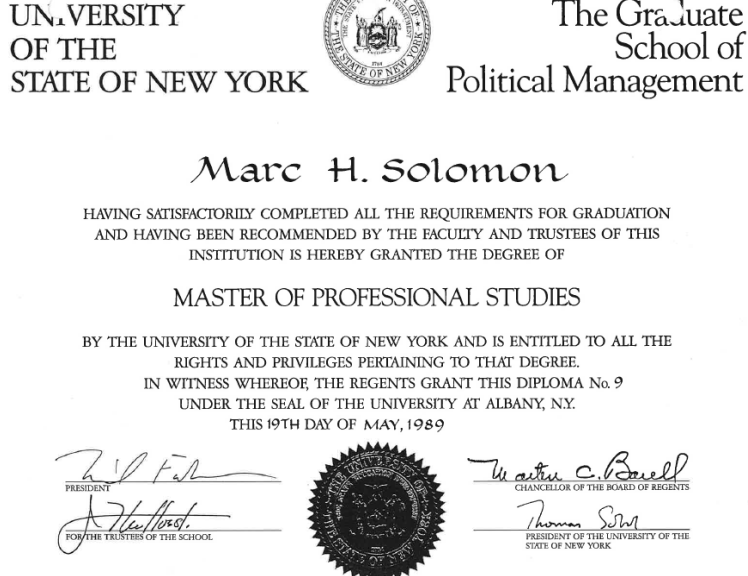
Two Diplomas

[caption id="attachment_713" align="alignleft" width="150" caption="Not like father..."][/caption]

Two diplomas collided with my in-box on an early fall in late summer Friday afternoon. The first was inspired by a background checking third-party.


Actually "third" is probably too intimate a term for the degrees separating the four alien parties who picked up my case and blindly resubmitted the same craven information collection request:


“Despite many attempts, we have not been able to verify your degree/attendance at George Washington University.  We are contacting you to ask that you send support documentation such as a transcript or copy of your diploma to verify your education there.”

In round one I responded with a 2002 email request for my Graduate School to produce an academic transcript when I flirted with a library of science degree. The punch-line that year was that the school had lost a good chunk of its earliest academic histories when the files were U-Hauled from East 18th Street in lower Manhattan. That was in 1991 when the school relocated from CUNY ("City University of New York")  to George Washington University. Librarian degree or no degree, no sane archivist is going to hang onto 9 year-old memoranda detailed a lost transcript.

But Friday after I got the second boilerplate of verify emptor I shifted out of email search and broke my nine-year silence with the school. After all, the 4th party background checkers didn't need my GPA -- they just wanted to know that I wasn't inventing a graduate degree in electing people to office. Could the aggravation be worth the excavation? Imagine what I learned in a class room impacting what I do for a living? "Nothing farfetched about that" I can almost fathom Neil Fabricant saying.

Fabricant was the school's founder. In 1986 he took out a full-page ad in the New York Times to drum up interest in a graduate program for political consultants -- the equivalent to the MBA for management consultants. He framed his pitch with a tag line I'll never forget:
"Politics is a good thing."

Fabricant was channeling Center of Politics Director Larry Sabato. He was trying to say that the art of the deal deserved a Master of Deal Arts. Hard to believe but it sounded as unfashionable in 1987 in the era of Lee Atwater as it does in the post debt ceiling recriminations of today. Then again who would start a political consulting school in NYC instead of DC? Maybe those obliterated records were supposed to remove any hint of this fundamental miscue. Back then the Shuttle was $49 so flying Mark Mellman, Doug Bailey, Celinda Lake et al. in weekly might have been plausible for one or two board meetings at best.

I remember another memorable tagline made by the school's first head of admissions, financial aid, and registrar named Christine Solomon who told me the school wanted its students to be "needs blind." This meant that we could gather up the courage to be the inaugural lab rats. Such gumption would release us from fretting over trivialities like student loans. At the time I was confused. Was she was trying to outfit my billfold with a blindfold or hold my blindside with a jello mold?

To others in the program this loan is blind first impression was prescient and they refused to pay their balances without qualifying first for the Neil Fabri-card. Years later something preordained in the unhappiness of those first class campers rubbed off on the crates of records in the U-HAUL on moving day. Since then, we specimens have been chasing down a credential I stopped using long before the age of the permanent campaign arrived.

On Friday the curse of the Fabricard, the jello mold, and Lee Atwater's tormented spirit all lifted. I reached three GSPM employees in a row who were all patient, resourceful, and ultimately effective in helping me produce the long delayed official degree conferred through the dazzle of scanned diplomas basking eternal in PDF splendor. The bureaucracy of the background checkers could now recede into a dormant state of permanent dimmer.

One Diploma, Two Graduations

No sooner had I thrown down the lights on my career in political degree recapture I got an attached PDF of my son's high school degree from the Seton Home Study program. Jerry finished his studies a month or two ago but the big momentous certificate arrived last week. He wasn't shouting or jumping up and down but "was very happy to have it" as is his accustomed state of graduated adulation. His mom held back the tears -- most of them anyhow.

But like son...
I'm glad that mom stayed on top of the situation. I'm grateful for her sacrifices as a home school educator. I'm glad that she stayed on top of the paperwork. I'm glad that our son won't be asking Seton administrators in 2034 to search on all the Jerry Solomons in their “early two thousands” archives. I can’t possibly know what it’s like to bring that diploma to life.

But I am perhaps most ultimately grateful that Jerry knows what it’s like to don the graduation gown and hat and walk with the Greenfield High School class of 2011 – something no virtual degree will ever confer. The fact his high school experience bears the certifiable and the ceremonious is a tribute to Jerry.

Loud and clear.

When the interim director of student affairs ran my name against her screen records last Friday, there were three Marc Solomons who appeared -- none of them related to Christine Solomon or myself.

Thursday, February 24, 2011

Plumbing Below the Radar


[caption id="attachment_534" align="alignleft" width="240" caption="Photo by Jim Henderson | jim@henderson.org.nz"][/caption]

"Never mistake your presence for the event."

- Roscoe Lee Brown

I'd like to say that the highlight of Tuesday's Open Mic Night was that I got to teach what I love in the manner I love doing it (teach). I'd like to affirm further that there was an airy effortlessness to the presentation. After all this was a captive, active group -- engaged, smart, skeptical -- all the requisite aptitudes. Finally I should clarify that the staging was in a stately conference facility with a robust wifi signal, no dial-in audience to accommodate, and most importantly ... no institutional middle man.

Truth is, the most gratification came from assembling two Boston-based information communities -- my PI/detectives and fellow SIKM colleagues -- then watching the collaboration fly across the conference table. The joy of discovery is one thing. But sharing that joy is pure rapture.

Kirstie Fiora filled in for my woeful event-planning deficits -- ushering in attendees past locked front doors and assorted roadblocks that escaped my logistical skills for bringing people together. I've been living off her Angie's Kettle Corn snack offering since the session ended. Pathetic.

In addition to Kirstie and brother Gordon, my improbable roundtable for round one included:

  • Ann O'Connor (PI) -- Researcher, International Brotherhood of Electrical Workers ("IBEW")

  • Carrie LaRose (PI) -- Comptroller, H&H Delivery

  • Dave Wallace (KM) -- Managing Partner, GameChange LLC

  • Joe Cadillic (PI) -- Private Investigator, Murphy & Associates

  • John Dalli (PI) -- Owner, Worcester Record Search

  • Kate Pugh (KM) -- President, Align Consulting

  • Paula Cohen (KM) -- Knowledge Manager, Information Enterprises


The premise of the News Radar theme was that we're fussing over stuff that should not rise to our radar levels. I demonstrated tools for flushing information waste products back down below the sewer line where they belong. On the attention scale we rake our mental bearings into three piles:

  1. PURPOSE: What makes our lives worth living

  2. OBJECTIVE: What do I do to make #1 happen

  3. DISTRACTION: What gets int the way of #2


Way too much of the web is sheltered under the growth of pile #3. That's where I introduced the pruning shears of semantics, syntax, and search operators for pruning away the rubbish. I also tried to give them some bearings on when a scarcity of information actually calls for expanding the boundaries through keyword cultivation or the simpler queries that create more productive outcomes in ponds (specialty databases) in lieu of oceans (commercial search engines).

These examples were modeled on the saving graces of an XML-centric approach for having useful information find us -- assuming that web searches don't fall in the #1 pile camp. We used syntax to forge for RSS feeds. We used semantics to develop some word algebraics for trapping some common corporate event triggers (marketing, finance, regulatory, musical management chairs, etc.) We even set up watch lists to ensnare specific people we might call on that we can insinuate by the job titles in the announcements of their promotions.

We tested the relationship of push and pull sourcing by using Site Explorer to compare self-referring links to external ones as an even-handed basis to gauge the credibility of information providers by their web domains and pages. Finally we went shopping for higher level concepts like citizenship in Google Keywords and came away with the humbling conclusion that "Citizen Watches" were likelier to tell us Google time better than the Bill of Rights. Another discrepancy worth noting is the number of searches generated for terms versus the ad dollars they fetch, e.g. "SAS Document Management" yielded 73 searches last month despite its "competitive" appeal to Google advertisers.

The one underwhelming demo I thought was the section on rolling your own custom search engines. We grouped media sources back into their traditional pre-web categories. Remember the term "paid media" to describe the success of 20th century PR campaigns?" Didn't think so. The disappointment was in the lack of evidence that the keyword refinements did much to skew the results or tell the underlying story of the custom search theme. I also flew over the information pond completely. That means I didn't focus much on using Google as the search engine of record in order to qualify and build contact lists from social media sites.

I'm looking forward to the next several sessions in Western Mass and will try to localize them. Candidate projects on the agenda? Building alumni lists from LinkedIn of Five College graduates.

Friday, October 8, 2010

LinkedIn First, LinkedOut Later...

To a metadata freak, LinkedIn is a marvel of information science. It is the botanical garden of social media.

Every germinating seed is dutifully watered in flower beds tended by a volunteer army of self-selected gardeners. The blossom worth budding here is that the attentiveness is anchored to the premise that our professional fortunes depend on this.

The LinkedIn premise is a massive database of self-administered professional life narratives. Access is determined by a network of click-happy connections: show you mine if you show me yours (both the resumes and the contacts).

The database gets regular feedings and weedings because -- hey -- those are my bowling trophies and and inflationary job titles and biopic documentaries I put on my reality series reward card program. Psst ... got any seed money?

What I'm unpacking here through unlicensed metaphor is a database of resumes. The splendor of the architecture is that the profile templates are self-organizing. There are no semantic web quibbles over taxonomies versus folksonomies, what vocabulary is worth controlling and which tag clouds deserve to float above the fog. In doing so, LinkedIn has achieved organic adherence to the age-old riddle:

How do I describe my uniqueness in the least invasive and most universal way possible?

That vessel is the cross-fertilization of the knowledge garden we researchers, sales animals, and job-seekers can all cultivate, horse-trade, or hunt down online through the sprinkler system known as LinkedIn's "advanced search features."

I did a session on this for the career options folks at my Alma mater of Hampshire College last month. It was fascinating to map the academic disciplines signified by each of the colleges schools to the requisite job skills, career paths, and institutional dimensions reverberating in the professional odysseys of Hampshire grads.

Then just last week I get pinged at work by Jon Lee, a Hampshire cohort from a 1.5 separation degree of overlapping concentric social circles circa 1980-84. Who better than a former Hampster and current job-seeker to put that ivory-coated knowledge harvest to the test?

Jon writes:

So, anyway, I want to harvest some of these connections. At first I thought I'd contact the person I knew, tell them who I was looking for and ask them to search the name and find the 2nd degree connection. A little awkward and time consuming (for the person I'm asking the favor). Yeah, so then I see the "Get Introduced Through A Connection" link. I choose my connection, then:


He continues...

My question is this... What happens, how does this work?

I hit send, a message goes to you. Do you only see my note to you - or the message to X (Leslie B. in this example) as well? And what about the person you know, who knows Leslie? How is that connection made? Automatically - or do you have to find the connection for me? Do they see my message to you, my message to Leslie?

The hypothetical scenarios go on for a few more paragraphs before the logic is tortured right out of the motivation for getting to the actual conversation stages -- the linking out phase of the process. I appreciate these questions because they underscore the associative clunk factor of shuffling through an overloaded circuit of lateral connectors.

The community spirit of pay-it-forward reciprocity might work for random acts of kindness. But maybe not so much for calculating and indiscriminate emails -- especially from people we know more for their degree of separation than we do about them. Period.

The artifice of the social media back-scratch points to the exit ramp or the link-out. This is the realization that as gorgeous as that well-groomed garden is, all the growth happens within the narrow confines of Linkedin.com. It is a walled in garden. That's why a thousand Facebook weeds makes more advertising perfume than the most painstaking bouquet of freshly cut resumes at LinkedIn.

You need to step on a few weeds, maybe even some poisonous ones before any meaningful conversations can happen. That's where a nose for research meets an eye for opportunity and an ear for discussion. That kind of growth can only happen in soils and climates where the greatest variety of vegetation takes root.

If I didn't answer your question, Jon, that may be because six years and 750 connections later, I still haven't plunked down $24.99 a month to find the answers.

LinkedIn First, LinkedOut Later...

To a metadata freak, LinkedIn is a marvel of information science. It is the botanical garden of social media.

Every germinating seed is dutifully watered in flower beds tended by a volunteer army of self-selected gardeners. The blossom worth budding here is that the attentiveness is anchored to the premise that our professional fortunes depend on this.

The LinkedIn premise is a massive database of self-administered professional life narratives. Access is determined by a network of click-happy connections: show you mine if you show me yours (both the resumes and the contacts).

The database gets regular feedings and weedings because -- hey -- those are my bowling trophies and and inflationary job titles and biopic documentaries I put on my reality series reward card program. Psst ... got any seed money?

What I'm unpacking here through unlicensed metaphor is a database of resumes. The splendor of the architecture is that the profile templates are self-organizing. There are no semantic web quibbles over taxonomies versus folksonomies, what vocabulary is worth controlling and which tag clouds deserve to float above the fog. In doing so, LinkedIn has achieved organic adherence to the age-old riddle:

How do I describe my uniqueness in the least invasive and most universal way possible?

That vessel is the cross-fertilization of the knowledge garden we researchers, sales animals, and job-seekers can all cultivate, horse-trade, or hunt down online through the sprinkler system known as LinkedIn's "advanced search features."

I did a session on this for the career options folks at my Alma mater of Hampshire College last month. It was fascinating to map the academic disciplines signified by each of the colleges schools to the requisite job skills, career paths, and institutional dimensions reverberating in the professional odysseys of Hampshire grads.

Then just last week I get pinged at work by Jon Lee, a Hampshire cohort from a 1.5 separation degree of overlapping concentric social circles circa 1980-84. Who better than a former Hampster and current job-seeker to put that ivory-coated knowledge harvest to the test?

Jon writes:

So, anyway, I want to harvest some of these connections. At first I thought I'd contact the person I knew, tell them who I was looking for and ask them to search the name and find the 2nd degree connection. A little awkward and time consuming (for the person I'm asking the favor). Yeah, so then I see the "Get Introduced Through A Connection" link. I choose my connection, then:


He continues...

My question is this... What happens, how does this work?

I hit send, a message goes to you. Do you only see my note to you - or the message to X (Leslie B. in this example) as well? And what about the person you know, who knows Leslie? How is that connection made? Automatically - or do you have to find the connection for me? Do they see my message to you, my message to Leslie?

The hypothetical scenarios go on for a few more paragraphs before the logic is tortured right out of the motivation for getting to the actual conversation stages -- the linking out phase of the process. I appreciate these questions because they underscore the associative clunk factor of shuffling through an overloaded circuit of lateral connectors.

The community spirit of pay-it-forward reciprocity might work for random acts of kindness. But maybe not so much for calculating and indiscriminate emails -- especially from people we know more for their degree of separation than we do about them. Period.

The artifice of the social media back-scratch points to the exit ramp or the link-out. This is the realization that as gorgeous as that well-groomed garden is, all the growth happens within the narrow confines of Linkedin.com. It is a walled in garden. That's why a thousand Facebook weeds makes more advertising perfume than the most painstaking bouquet of freshly cut resumes at LinkedIn.

You need to step on a few weeds, maybe even some poisonous ones before any meaningful conversations can happen. That's where a nose for research meets an eye for opportunity and an ear for discussion. That kind of growth can only happen in soils and climates where the greatest variety of vegetation takes root.

If I didn't answer your question, Jon, that may be because six years and 750 connections later, I still haven't plunked down $24.99 a month to find the answers.

Monday, June 14, 2010

Me and God at Hampshire


Fullest disclosure: I have experienced nirvana on earth. It's a place where you set the bar in terms of expectations around what to learn, how to learn it and who you're learning it with. It's called Hampshire College. The good news is that I realized what a blessing this was as it passed by. The downside is that assembling a Div II committee has as much to do with getting a job as interdisciplinary crossovers have to do with the marketability of a Hampshire degree. Not much.

I conveyed those post graduating years of buyer's remorse to Greg Prince at last week's Hampshire's 40th anniversary weekend and he had an interesting and market-worthy response. He said that he didn't report to a jerk until the ripe old age of 45. He said a little post grad adversity might have helped him better handle this high probability event.

Greg also weighted in on who came back to camp Hamp. He said that most college reunions pull on the impulses of the founding classes and the more recent rounds. In the case of my Alma mater that means any cycle from the mid seventies through the pre-aughties only accounted for about half the attendees.

But even though the numbers didn't support too many chance double takes and flash memory floods there were enough ancestral underpinnings to leave this celebration to redemptions of far greater consequence than chance. In fact when a current student used a Q&A session as a chance to parade his grievances with the administration in front of us bystander alumns.

I turned to a total alum stranger and we shared the uncanny sensation that these peeves were of a perennial vintage and could be vented on any administration by the close of any semester (not to diminish the hopes that inspire these hard questions!) Perhaps the ultimate icon of Hampshire uniformity was Eugene Mirman's observation that the Q&A sessions of all workshops began with some grad saying how very interesting the discussion had been. "Now for the next ten minutes I want to talk about something very weird and only vaguely related to the topic we've come to discuss."

It's especially comic that Mirman picks up on the digressive patterns formed in the first workshop I attended on the role of improv comedy in schools led by Ari Friede 87F and Tim Sniffen 87F. Their whole inclusionary bent is to own up to accusations: "yes, I'm that jerk" as a way of moving beyond blame association. The tool they stressed was to append "yes, and..." to the dissenting opinion as a way of steering towards a defensible consensus. In practice the best response to "this is a terrible situation" is "yes -- and we have to deal with this." Subtext: you are stagnant, lonely, isolated, and we need to find our way out of this toxic environment. I liked the hand gestures for facilitating the consensus-taking temperature in larger groups. For or against could be responded to as five fingers (on board), 2 and-a-half fingers (halfway) or a fist (completely resistant). Great feedback tool.

I volunteered to perform an open cycle of "yes, and" loops with another alum and found it revealing (and humbling) how much I was closing off the discussion rather than opening it up. And I wonder why I'm hard to collaborate with!

The next session was called Making Media -- the Emerging Futures. Too much of this resembled a corporate round table about where to park your investment dollars -- the answer for now is cable. Higher abstractions like the future of journalism and participatory democracy were either trampled by this quarter's P&L or tabled in favor of some future business model that could restore our collective sense of 20th century equilibrium -- a trained cadre of reporters that process raw information into meaningful know-how.

Jonathan Friedland 77F hinted at the direction this was heading: "People pay for mobil information." What I infer? The difference between a set of Google results and the five restaurants on your iPhone that won a certain dining award is that you're going to act on the latter -- that's where the justification sets in. Eve Burton 78F reported one hopeful reference to Hearst's Times Citizen Union paper in Albany and how ad revenues were spiking on the days the staff promises to nail indefensible officials through a concerted effort to do hardcore investigative reporting.

Less sanguine was Jonathan's summation of his employer's assessment that what's bad for papers "is good for Disney" in the same way that anyone with a wholesale message to sell is happy to sidestep the retailer (or in this case the distributor). The biggest buzz in that message this week is getting consumers to buy their Toy Story 3 tickets online and inviting their Facebook friends to go with them. Groups of 80-90 have vouched for their love of Buzz, Andy, and the distribution model.

The last session (and the one where I bumped into former President Prince) was Dirty, Rotten Capitalism: Hampshire College Entrepreneurs Challenge the Hampshire Status Quo. This title implies an inverse relationship between the corporate and the public interest. Fortunately this session was about the attendees, not the facilitators, one of whom posed the ultimate gold standard for self-referential alumni objectives: how can we create more of me? Gratefully, the collective weight of the topic was not bogged down in Hampshire dogma and mis-applied correlations between self and collective interest.

My favorite response to the alumni role wasn't about "learning" or inbred innovation but having it "beaten into them" by the schlub factor -- the fear of being anything other than average that permeates the risk-averse boards of nonprofits -- why would nonprofits deserve any less non-protection than for-profits?

On the chance meeting front I couldn't pass Margaret Cerullo in the airport lounge without rekindling the memory of Michael Current. In fact his presence reverberates more greatly than any of the earthbound friends still within our midst. I talked up my Internet Research course with Aaron Berman. I also met up with Joel Olicker and reinvested my admiration for his prescient Greening of Northampton documentary. Perhaps Joel will release his musty master from the shackles of 3/4" in the less-than-handy industrial box. I also found the ever-humble and legendary "Gunther" who has been forever the guardian angel of the Hampshire video community.

John is the guy who makes the things happen in the overpriced collateral that school cranks out. Of course John has always existed several beaming signals under the official radar and that beacon continues to shine because of John's love of the work that Hampshire students produce. Does he care about hierarchy? Does he feel slighted for all the non-promotions that never broke his way? He could not be bothered less. In fact the one remark he took personally was when I told him that of my twenty addresses Amherst was the only place worthy of a return ticket. Now, that's an endorsement worth ringing.

Gunther did say something I found puzzling, flattering, and galling all in one breath. He said that mine was the "golden era" of Hampshire video -- as if the show Infinity would go on forever? To be more specific he said that the school lost momentum with the departure of Jerry Liebling and Greg Jones, perhaps because their interdisciplinary focus was framed by real world practicality. Man, just to hear the title "Visual Literacy" come up in cocktail reception conversation sent me to the warmest of fuzzy places.

One of many unplanned newer acquaintances sprung from a Gunther conversation including Jud Willmont F92 who produced "A Taiji Journey" -- a work on his father's odyssey to China to connect with his Taoist pathways. While we were viewing the work I was reconnecting with my first memories of the basement TV studio -- inaugurated as the spanking new color video mecca when Mark Geffen's Beckettesque dad played the title role in his 1984 revival of Krapp's Last Tape.

The Malarians: Head Music Meets Thundering Heart

Finally there was the house of Hampshire band -- those maverick, raving, psychedelic Malarians. The band, fighting trim in their navy blue turtlenecks, was in midseason form despite a double-decade hiatus. The animated tour-storming and play-list was finally unsealed in their recent Boston, Worcester, and NoHo gigs. Reading glasses anyone?

The irreverence began with a manic and cuddly Mal Thursday trampling over the reputation of the current ex-Yalee President. On what grounds? On the suspicion that a gradeless div system was being drummed out of Hampshire diplomas and replaced with the dreaded accuracy of academic "standards."

As the heavens pissed down some hard rains the dance floor broke open in a mindless abandon. And what burdens were abandoned for this fleeting revival? Pretty much anything a former Hampster does to get by in this the big, square world. Yup.

All those out-of-Hamp accommodations gave rise to the soaring harmonies and sonic exuberance of these garage legends on a stormy, raw Saturday night under the clammy circus tent. Those dance steps were not made or born but grateful for their improbable pirouttes through makeshift sanctuaries of past and future. Non satis scire: To know is not enough and the Malarians had us leaving the banquet hungry for more.

Me and God at Hampshire


Fullest disclosure: I have experienced nirvana on earth. It's a place where you set the bar in terms of expectations around what to learn, how to learn it and who you're learning it with. It's called Hampshire College. The good news is that I realized what a blessing this was as it passed by. The downside is that assembling a Div II committee has as much to do with getting a job as interdisciplinary crossovers have to do with the marketability of a Hampshire degree. Not much.

I conveyed those post graduating years of buyer's remorse to Greg Prince at last week's Hampshire's 40th anniversary weekend and he had an interesting and market-worthy response. He said that he didn't report to a jerk until the ripe old age of 45. He said a little post grad adversity might have helped him better handle this high probability event.

Greg also weighted in on who came back to camp Hamp. He said that most college reunions pull on the impulses of the founding classes and the more recent rounds. In the case of my Alma mater that means any cycle from the mid seventies through the pre-aughties only accounted for about half the attendees.

But even though the numbers didn't support too many chance double takes and flash memory floods there were enough ancestral underpinnings to leave this celebration to redemptions of far greater consequence than chance. In fact when a current student used a Q&A session as a chance to parade his grievances with the administration in front of us bystander alumns.

I turned to a total alum stranger and we shared the uncanny sensation that these peeves were of a perennial vintage and could be vented on any administration by the close of any semester (not to diminish the hopes that inspire these hard questions!) Perhaps the ultimate icon of Hampshire uniformity was Eugene Mirman's observation that the Q&A sessions of all workshops began with some grad saying how very interesting the discussion had been. "Now for the next ten minutes I want to talk about something very weird and only vaguely related to the topic we've come to discuss."

It's especially comic that Mirman picks up on the digressive patterns formed in the first workshop I attended on the role of improv comedy in schools led by Ari Friede 87F and Tim Sniffen 87F. Their whole inclusionary bent is to own up to accusations: "yes, I'm that jerk" as a way of moving beyond blame association. The tool they stressed was to append "yes, and..." to the dissenting opinion as a way of steering towards a defensible consensus. In practice the best response to "this is a terrible situation" is "yes -- and we have to deal with this." Subtext: you are stagnant, lonely, isolated, and we need to find our way out of this toxic environment. I liked the hand gestures for facilitating the consensus-taking temperature in larger groups. For or against could be responded to as five fingers (on board), 2 and-a-half fingers (halfway) or a fist (completely resistant). Great feedback tool.

I volunteered to perform an open cycle of "yes, and" loops with another alum and found it revealing (and humbling) how much I was closing off the discussion rather than opening it up. And I wonder why I'm hard to collaborate with!

The next session was called Making Media -- the Emerging Futures. Too much of this resembled a corporate round table about where to park your investment dollars -- the answer for now is cable. Higher abstractions like the future of journalism and participatory democracy were either trampled by this quarter's P&L or tabled in favor of some future business model that could restore our collective sense of 20th century equilibrium -- a trained cadre of reporters that process raw information into meaningful know-how.

Jonathan Friedland 77F hinted at the direction this was heading: "People pay for mobil information." What I infer? The difference between a set of Google results and the five restaurants on your iPhone that won a certain dining award is that you're going to act on the latter -- that's where the justification sets in. Eve Burton 78F reported one hopeful reference to Hearst's Times Citizen Union paper in Albany and how ad revenues were spiking on the days the staff promises to nail indefensible officials through a concerted effort to do hardcore investigative reporting.

Less sanguine was Jonathan's summation of his employer's assessment that what's bad for papers "is good for Disney" in the same way that anyone with a wholesale message to sell is happy to sidestep the retailer (or in this case the distributor). The biggest buzz in that message this week is getting consumers to buy their Toy Story 3 tickets online and inviting their Facebook friends to go with them. Groups of 80-90 have vouched for their love of Buzz, Andy, and the distribution model.

The last session (and the one where I bumped into former President Prince) was Dirty, Rotten Capitalism: Hampshire College Entrepreneurs Challenge the Hampshire Status Quo. This title implies an inverse relationship between the corporate and the public interest. Fortunately this session was about the attendees, not the facilitators, one of whom posed the ultimate gold standard for self-referential alumni objectives: how can we create more of me? Gratefully, the collective weight of the topic was not bogged down in Hampshire dogma and mis-applied correlations between self and collective interest.

My favorite response to the alumni role wasn't about "learning" or inbred innovation but having it "beaten into them" by the schlub factor -- the fear of being anything other than average that permeates the risk-averse boards of nonprofits -- why would nonprofits deserve any less non-protection than for-profits?

On the chance meeting front I couldn't pass Margaret Cerullo in the airport lounge without rekindling the memory of Michael Current. In fact his presence reverberates more greatly than any of the earthbound friends still within our midst. I talked up my Internet Research course with Aaron Berman. I also met up with Joel Olicker and reinvested my admiration for his prescient Greening of Northampton documentary. Perhaps Joel will release his musty master from the shackles of 3/4" in the less-than-handy industrial box. I also found the ever-humble and legendary "Gunther" who has been forever the guardian angel of the Hampshire video community.

John is the guy who makes the things happen in the overpriced collateral that school cranks out. Of course John has always existed several beaming signals under the official radar and that beacon continues to shine because of John's love of the work that Hampshire students produce. Does he care about hierarchy? Does he feel slighted for all the non-promotions that never broke his way? He could not be bothered less. In fact the one remark he took personally was when I told him that of my twenty addresses Amherst was the only place worthy of a return ticket. Now, that's an endorsement worth ringing.

Gunther did say something I found puzzling, flattering, and galling all in one breath. He said that mine was the "golden era" of Hampshire video -- as if the show Infinity would go on forever? To be more specific he said that the school lost momentum with the departure of Jerry Liebling and Greg Jones, perhaps because their interdisciplinary focus was framed by real world practicality. Man, just to hear the title "Visual Literacy" come up in cocktail reception conversation sent me to the warmest of fuzzy places.

One of many unplanned newer acquaintances sprung from a Gunther conversation including Jud Willmont F92 who produced "A Taiji Journey" -- a work on his father's odyssey to China to connect with his Taoist pathways. While we were viewing the work I was reconnecting with my first memories of the basement TV studio -- inaugurated as the spanking new color video mecca when Mark Geffen's Beckettesque dad played the title role in his 1984 revival of Krapp's Last Tape.

The Malarians: Head Music Meets Thundering Heart

Finally there was the house of Hampshire band -- those maverick, raving, psychedelic Malarians. The band, fighting trim in their navy blue turtlenecks, was in midseason form despite a double-decade hiatus. The animated tour-storming and play-list was finally unsealed in their recent Boston, Worcester, and NoHo gigs. Reading glasses anyone?

The irreverence began with a manic and cuddly Mal Thursday trampling over the reputation of the current ex-Yalee President. On what grounds? On the suspicion that a gradeless div system was being drummed out of Hampshire diplomas and replaced with the dreaded accuracy of academic "standards."

As the heavens pissed down some hard rains the dance floor broke open in a mindless abandon. And what burdens were abandoned for this fleeting revival? Pretty much anything a former Hampster does to get by in this the big, square world. Yup.

All those out-of-Hamp accommodations gave rise to the soaring harmonies and sonic exuberance of these garage legends on a stormy, raw Saturday night under the clammy circus tent. Those dance steps were not made or born but grateful for their improbable pirouttes through makeshift sanctuaries of past and future. Non satis scire: To know is not enough and the Malarians had us leaving the banquet hungry for more.

Tuesday, May 25, 2010

Merger in the First Degree (and 2nd and 3rd)


The SIKM Boston group convened last week for a lively workshopping session. There was lots of discussion and very little discussion on what to discuss. The focus? What to do when peering straight into the inscrutable eyes of Chess Piece Face. Yes. we're talking about takeovers of the most alien kind across the hostility spectrum. I especially liked the idea that the discussion gravitated to source conjugation:

* First degree: what can I do unilaterally to keep my job?
* Second degree: what can I do to convince you?
* Third degree: how would the disinterested consultant organization counsel their acquirer-client?

The premise starts not with the pieces but the game board. The game we're playing is capitalism and the rules are by, for, and to the owners of capital. Us custodians, gardeners, farmers, bodyguards, and gatekeepers must take in a deep breath and a full step back from our cubes and Outlook boxes at the dawn of a newly waking work day, knowing that the lights may already be turned off.

To be on board is to be prepared to jump ship once the manifesto has passed from one shipping magnet to the next. The crew, however, is not part of the negotiation or even the inventory. To miss that reality is to be held hostage to our own lethargy and inflated sense of importance. Unlike the good captain, we can't go down with the ship. It's not our board to begin with.

Part of the ship-jumping drill is conducted in the self-renewal of our daily vows (including refresher swimming lessons). From the first degree perspective Kate Pugh recommends declaring "a major" to resist being tagged as cargo (overhead). In the consolidations to come it helps to eclipse counterpart "majors" by playing the "best practices" hand in trying to stave off commodity status and marginalization. I concede that the part about personal branding and sucking up to the brigadier smacks of a Fast Company survival guide written by that same doomed captain after the life boats have left for good. Animal magnetism is what seals deals and wins business. There are limits, however, to personal charisma outside the school of self-preservation.

The options seem more leveragable in the second degree where self-declared majors can double as brokers for the teams they've assisted and the projects they've led. One of the more thoughtful second degree contributions to our meeting came from Dave Wallace who spoke in terms of what farmers provide hunters in acquisition terms that is also certain not to show up on a balance sheet:

"How do you reward firefighters for the fires that never happen? he asks. "How can you document that demonstrated ability to diffuse the crises?"

Here it helps to take a page out of Kate's playbook for connecting personal outputs to winning outcomes by elevating those contributions to revenue-generating status. Dave was also quick to address the match-ups and shake-outs around the re-ordering of org charts: who is your equivalent in the new organization? Do they have a higher title, a lower salary band? What expectations do they answer to and what problems do they resolve?"

The third degree is about the ultimate out-of-body merger drama. The active disinterest that speaks to the dispassionate observance for how outsiders advise their conquering clients to carve out the crown jewels of the predatory spoils. Beyond the aggressive cost-cutting that finds a home in bull and bear markets alike there is the need to safeguard the knowledge flows that drive the sales cycles -- not just the profit centers they flow to. I've always carried this implicit understanding with the type A bosses I've supported in their sales efforts. KMA's Mike Gilronan was incredulous how under the radar this realization lands on the operational side: "Some non-revenue-bearing folks don't get it -- How do we justify ourselves?" This is not a rhetorical question to Mike: "Have you ever been held to a quota?"

That unwritten contract trades knowledge flows in the form of competitive intelligence, task-based search results, and accelerated proposal generation for job security. Pure and simple. The easiest way to demonstrate this systemically to an outsider.

That's where the appeal of an enterprisewide tool like SharePoint can play to a farmer's advantage. There's nothing a hunter-gatherer likes better than the map to the treasure -- especially if it spares them any unnecessary turf battles or homegrown improvised explosives designed to blow-up in their faces. That's the beauty of what Chris Rivinus described in my KMWorld Reality Series as the Rorschach test-like properties of SharePoint.

It's a system designed to unify and synchronize all the moving pieces -- prized assets and headcounts alike. Flush the red dye of a bloodless acquisition coup through the SharePoint plumbing and you'll see where the information travels through the anatomical heart of the enterprise. Conversely you'll see the blockages too -- where gangrene is setting into the outer corporate limbs because of information-hoarding, silo-keepers, and other forms of fear, loathing, and clog-hardening lethargy.

Here's a conversation that an acquisition leader and a SharePoint manager can have. It's not "take me to your leader." It's more like the building inspector flushing the pipes to show the rust in the plumbing. That's the kind of knowledge that transcends where the bones are buried and speaks to where the integration needs to happen -- hint: it lies below the financial reporting radar.

Sadie Van Buren referenced the ultimate third degree solution based on a New York City-based copy editor who joined Google Adsense and gamed the vanity results. Every time the agency googled itself it got the gamer's resume. He got his choice of offers.

Merger in the First Degree (and 2nd and 3rd)


The SIKM Boston group convened last week for a lively workshopping session. There was lots of discussion and very little discussion on what to discuss. The focus? What to do when peering straight into the inscrutable eyes of Chess Piece Face. Yes. we're talking about takeovers of the most alien kind across the hostility spectrum. I especially liked the idea that the discussion gravitated to source conjugation:

* First degree: what can I do unilaterally to keep my job?
* Second degree: what can I do to convince you?
* Third degree: how would the disinterested consultant organization counsel their acquirer-client?

The premise starts not with the pieces but the game board. The game we're playing is capitalism and the rules are by, for, and to the owners of capital. Us custodians, gardeners, farmers, bodyguards, and gatekeepers must take in a deep breath and a full step back from our cubes and Outlook boxes at the dawn of a newly waking work day, knowing that the lights may already be turned off.

To be on board is to be prepared to jump ship once the manifesto has passed from one shipping magnet to the next. The crew, however, is not part of the negotiation or even the inventory. To miss that reality is to be held hostage to our own lethargy and inflated sense of importance. Unlike the good captain, we can't go down with the ship. It's not our board to begin with.

Part of the ship-jumping drill is conducted in the self-renewal of our daily vows (including refresher swimming lessons). From the first degree perspective Kate Pugh recommends declaring "a major" to resist being tagged as cargo (overhead). In the consolidations to come it helps to eclipse counterpart "majors" by playing the "best practices" hand in trying to stave off commodity status and marginalization. I concede that the part about personal branding and sucking up to the brigadier smacks of a Fast Company survival guide written by that same doomed captain after the life boats have left for good. Animal magnetism is what seals deals and wins business. There are limits, however, to personal charisma outside the school of self-preservation.

The options seem more leveragable in the second degree where self-declared majors can double as brokers for the teams they've assisted and the projects they've led. One of the more thoughtful second degree contributions to our meeting came from Dave Wallace who spoke in terms of what farmers provide hunters in acquisition terms that is also certain not to show up on a balance sheet:

"How do you reward firefighters for the fires that never happen? he asks. "How can you document that demonstrated ability to diffuse the crises?"

Here it helps to take a page out of Kate's playbook for connecting personal outputs to winning outcomes by elevating those contributions to revenue-generating status. Dave was also quick to address the match-ups and shake-outs around the re-ordering of org charts: who is your equivalent in the new organization? Do they have a higher title, a lower salary band? What expectations do they answer to and what problems do they resolve?"

The third degree is about the ultimate out-of-body merger drama. The active disinterest that speaks to the dispassionate observance for how outsiders advise their conquering clients to carve out the crown jewels of the predatory spoils. Beyond the aggressive cost-cutting that finds a home in bull and bear markets alike there is the need to safeguard the knowledge flows that drive the sales cycles -- not just the profit centers they flow to. I've always carried this implicit understanding with the type A bosses I've supported in their sales efforts. KMA's Mike Gilronan was incredulous how under the radar this realization lands on the operational side: "Some non-revenue-bearing folks don't get it -- How do we justify ourselves?" This is not a rhetorical question to Mike: "Have you ever been held to a quota?"

That unwritten contract trades knowledge flows in the form of competitive intelligence, task-based search results, and accelerated proposal generation for job security. Pure and simple. The easiest way to demonstrate this systemically to an outsider.

That's where the appeal of an enterprisewide tool like SharePoint can play to a farmer's advantage. There's nothing a hunter-gatherer likes better than the map to the treasure -- especially if it spares them any unnecessary turf battles or homegrown improvised explosives designed to blow-up in their faces. That's the beauty of what Chris Rivinus described in my KMWorld Reality Series as the Rorschach test-like properties of SharePoint.

It's a system designed to unify and synchronize all the moving pieces -- prized assets and headcounts alike. Flush the red dye of a bloodless acquisition coup through the SharePoint plumbing and you'll see where the information travels through the anatomical heart of the enterprise. Conversely you'll see the blockages too -- where gangrene is setting into the outer corporate limbs because of information-hoarding, silo-keepers, and other forms of fear, loathing, and clog-hardening lethargy.

Here's a conversation that an acquisition leader and a SharePoint manager can have. It's not "take me to your leader." It's more like the building inspector flushing the pipes to show the rust in the plumbing. That's the kind of knowledge that transcends where the bones are buried and speaks to where the integration needs to happen -- hint: it lies below the financial reporting radar.

Sadie Van Buren referenced the ultimate third degree solution based on a New York City-based copy editor who joined Google Adsense and gamed the vanity results. Every time the agency googled itself it got the gamer's resume. He got his choice of offers.
Bookmark and Share

About attentionSpin

My photo
attentionSpin is a consulting practice formed in 1990 to create, automate and apply a universal scoring system (“The Biggest Picture”) to brands, celebrities, events and policy issues in the public eye. In the Biggest Picture, attentionSpin applies the principles of market research to the process of media analytics to score the volume and nature of media coverage. The explanatory power of this research model: 1. Allows practitioners to understand the requirements for managing the quality of attention they receive 2. Shows influencers the level of authority they hold in forums where companies, office-seekers, celebrities and experts sell their visions, opinions and skills 3. Creates meaningful standards for measuring the success and failure of campaigns and their connection to marketable assets.